Fog City Boy #5.1 (republished)

Fog City Boy on the Camino Português

Condeixa-a-Nova, Portugal – April 17, 2014

Dear readers, it has been nine days since I last posted, but not for lack of interest and resolve on my part. The Way has taken me to various locales that either lacked a facility that sported on-line capability, or in one case, had the capacity but had no connectivity. Quite frustrating.

I will not tell all the tales of my adventures since Santarem, but will save some for a future post.

Vilafranca de Xira and Santarem have served as two staging points for me during the early phase of the Camino Portugues. Finding a suitable location and hunkering down there for a day or two or more has been a practical solution for me in a locale that does not yet sport the infrastructure to support a Camino in the style of the Camino Frances. That Camino generally has albuerques every few kilometers where a weary perigrino can just give it up for the day, get a bunk and a shower (assuming there is space), or go on a few more kilometers to the next alberque if availability is lacking or if energy permits. Such is not yet the case south of Porto on the Camino Portugues. So using one town where lodging can be found as a base of operations – traveling by train or bus to start a day’s hike (beginning where one left off the day before and returning to base to begin again on the next day) has proved a workable solution to the infrastructure challenge.

Arriving in Santarem was instructional for me. I had walked a long way the day before and taken the train from Vilafranca to establish a new base of operations in Santarem. I noted a pension near the railroad station, inquired about availability, and was shown a room. I gave it a cursory look, agreed to stay for three nights at €10 per night (I should have awakened at that point), put down my pack and went back to the station to head back south and start my day’s hike. I got rained on most of the day, was tired, and ferociously in need of a shower. I had the key to the room in the pension, walked in, looked around, noted that there was no heat, checked the facility down the hall (toilet was clean but no toilet seat available) observed the pillows stored in the wardrobe to be about as solid as a dustmop . . . and was appalled that I had booked myself into this dump.

Fast forward, I found a cafe, had a glass of wine, and asked the keeper where there was a hotel in the neighborhood. He obliged and . . . fast forward again . . . I recovered my pack, abandoned the pension and had a nice stay in the clean, heated, well-located hotel (toilet seat included at no extra charge). And an added benefit – there was a very good Chinese restaurant near by! Why eat Chinese when Portuguese is available? Frankly, it is because the Chinese know about vegetables and don’t include fried potatoes with every lunch and dinner. Sadly, Portuguese cuisine does not (at least so far).

A key takeaway from this experience was that I must take pains not to fall vicitim to an impatience to "get on with it – move ahead – don’t delay."

The good news is that I haven’t booked myself into a dump since.

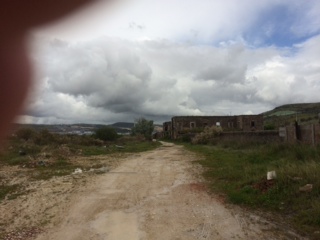
On the morning of my departure from Santarem, I made my way down a steep two-lane and heavily traveled winding road past a mideval fort that guarded one of the approaches to Santarem, the regional headquarters of the Roman administration centuries ago. Look closely in the dense foliage.
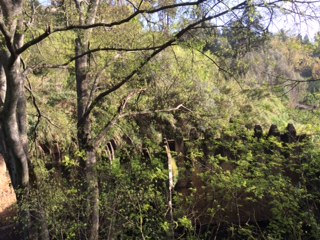
Eventually I arrived at the train station and back tracked just a bit to a little hamlet (Ribeira de Santarem) hovering over the Portuguese National Railway mainline to the north where I picked up the familiar yellow arrows and crossed into lovely agricultural territory making use of a midieval stone bridge that has been maintained, updated, and is in regular daily use.
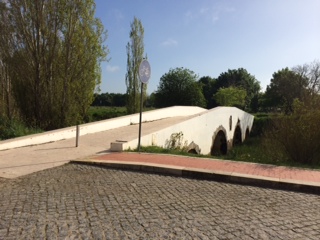
In passing I feel compelled to note that the little hamlet sports a grade crossing on the heavily traveled mainline. Yes, there are warning bells and safety barriers on each side of the crossing, but it is a miracle that the local cemetary is not filled with unfortunates who didn’t make it across. And let me speak specifically to the high speed trains that use the line. I don’t mean the regional and long haul trains that fly by at 100-120 km/hour. I mean bullet trains that can achieve speeds of 220 km/hr. I’ve had several fly by when I was standing on a station platform adjacent to the track they used, and it’s a bit scarry as those trains travel past in a blur.

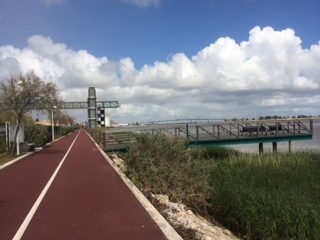
The land in the plains surrounding Santarem is fertile and the farmers seem prosperous – both large and small. Planting was underway as I passed through. Some established crops were starting to respond to the springtime weather. Commercial size vineyards were common along the way, and small ones in backyards were too. As were the occasional orange and lemon trees in both town and country sideyards. Olive orchards are ubiquitous.
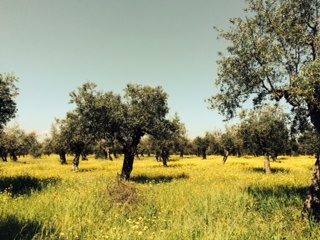
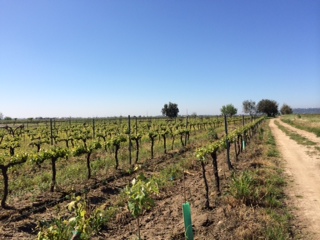
Until I embarked upon this phase of the Way, I was really traversing Lisbon and its far flung suburbs and exurbs. The feeling now is quite different. Sure, there are some towns of noticable size, but the villages and hamlets between them, and even the architechture in those larger towns, is different – less urban, more traditional: Older construction with whitewashed walls and red terracota tile roofs.

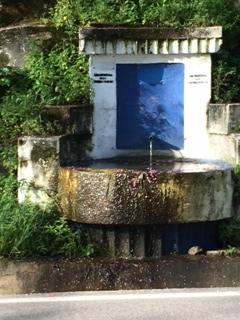
And barking dogs both in the country and in the towns. Some leashed, some not! Fountains are common though likely not used as much as historically was the case.
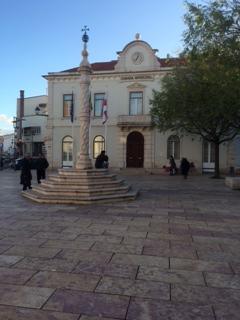
The bell in the church tower announces each passing hour. (The image below is actually in Golega, one of the not-so-small – pop. 6000 – towns where I overnighted. The church is a 14th century parish church noted for its Manueline door.)

And monuments, large and small, to Portugal’s heroic past keep the present in a perspective with the past, both with respect to religion, and the expulsion of the Moors and the establishment of Portugal as a nation in its own right.

I made my way north to Golegã which is a pleasant town famous for its horses and horsetraining activities. The town has determined to popularize doing the Camino Portuguese on horseback! Which is all well and good, but the way marks they have established are for cavaleiros, not for peregrinos on foot! I got thoroughly lost entering town, but luckily found my way to a pleasant pension/alberque with quite elaborate facilities in what had been the town home of a family of considerable means.

I was directed to the location by the Bombieros Voluntarios – the volunteer firemen – volunteers because they volunteer for the servise, not because they are uncompensated. They have firetrucks and ambulances and would be quite at home in a large or small town in the US. They were kind and sent me to my destination swiftly. They recommended a restaurant across the street from the pension, which I explored and where I had dinner. The entrepreneur showed me around the facility which was quite stubstantial, and sadly, quite devoid of other guests. A large oven facility for roasting pigs, storage for the wood chips he uses for heat and for flavoring, and lockers to store his inventory. His English was ok and my Portuguese, of course, non-existant. But we made ourselves understood. After my dinner and when his wife came home and took charge of their young daughter, he insisted that I go with him in his car to see the town. I agreed, and away we went. His tour was quite throrough and included the horse-training academy as well as substantial municipal structures. He complained about the economy and the belt-tightening measures that have been imposed by the government at the behest of other members of the Eurozone. And clearly, his business has suffered as have those of many other small business people in all the towns through which I have passed.

On the next day, I made it to my destination timely, but I had had concerns that I would not find lodging there. The proprietress of the pension where I stayed in Golega had offered to drive to my destination, collect me, and take me somewhere that would provide lodging, if I could not stay where I intended. That turned out not to be a problem. But what struck me about her kindess, and that of the restauranteur who gave me a tour of the town, not to mention motorists stopping to offer me a lift from time to time, is the genuine friendly offers extended by the Portuguese people directed at this perigrino, and I am sure, all others. Quite heartening.

I celebrated finding lodging in Vila Nova Barquina (between Golega and Tomar) by hiring a taxi and inspecting a Knights Templar castle not far away.
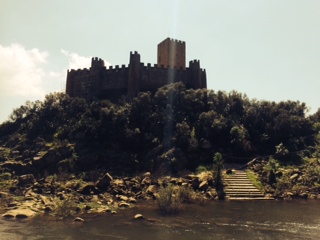
With that, I’m off.

Knute Michael

Fog City Boy #4.1 (republished)


Fog City Boy on the Camino Portugués

Dear friends, I hope that this republished version of Fog City Boy #4 captured the images successfully. If so, the credit goes to son Noah. If not, the blame is mine. FCB

Santarem, Portugal – April 8, 2014

I did not remark it in my previous post, but for the record, I started the first day of the Camino (before sending Fog City Boy #3 to print) by doing my AI (active isolated) stretches to prepare body, mind and spirit for the endurance event upon which I was about to embark. Boy was I happy that I did so. The muscles were tight and happy for the attention! And for you doubters out there, yes I did a two minute forward plank. (Technical note: An AI stretch is the opposite of a static stretch, often used in yoga and pose-oriented endeavors.)

On the first day’s journey, I got the first stamp in my Credencial de Pregrino, crossed the street to my pension (where the matron of the house insisted on stamping my Credencial with the stamp of the house, donned my back pack and my Tilley (broad brimmed hat) and stepped out into the rain.

Portugal has a maritime climate so rain is hardly unusual, especially in the spring and fall. The rain was gentle and I blithely headed out in to it. I deviated from the way marked path to visit the railroad station to pick up a timetable for later use (which it turned out they didn’t have) and returned to my travels, only to discover that I had lost my way and I hadn’t even gotten a half kilometer from my point of origin!

I was able to intuit where I ought to be and headed in that direction, but realized that I had gotten it wrong. So I made a new choice of corrective direction, proceeded, and in several blocks saw . . . a small yellow arrow indicating that peregrinos should continue on that street in the same direction.

There were several times that afternoon when I was uncertain of my path. I back tracked and determined that even if there wasn’t a confirming way mark, at least I hadn’t missed one along the way. Eventually another discrete little arrow showed me the way.

The Camino follows the River Tejo for some distance, heading northeasterly from Lisbon. The area through which I passed on that first day was given to light industry and manufacturing. There was a small container cargo terminal with a small (say 500 foot) container ship underway. It had equipment to work its own cargo but appeared to be leaving the berth. I’m not sure why a ship of that size needed a tug tethered to the stern as opposed to the stern quarter, but that was the case. I’m sure the pilot knew how to do the job.

The rain came and went but it was not an impediment to forward progress.

At the end of the long street among the working and abandoned manufactories, I came upon a grand structure that must have housed the offices controlling the factory spread out behind.

The building faced a small balloon shaped park dividing traffic on the thoroughfare. The park serves today as the terminus of a bus line. Narrow gauge tracks poking through the pavement at the top of the balloon confessed its earlier history as the terminus of one of the many tram lines that blanketed Lisbon in days gone by. This one built, no doubt, to carry workers to and from their respective places of employment.

I headed on, eventually passing under a highway viaduct and was pleased to see a yellow X on the back of a street sign, just adjacent to a zebra walk. How thoughtful, thought I, that the Confraternity alerted me to cross the street at this point! I did, and continued on, eventually inspecting the back sides of elegant apartment houses with their loading docks and trash bins. I pressed on.

Eventually, it occurred to me that I was again lost. Had I misinterpreted the yellow X? Well. . . yep. The yellow X means, “Pilgrim, don’t go this way.” I had missed the intended way mark and wandered off in my own direction. But all was not lost. I found myself at the Oriente Station of the Lisbon Metro and the Portuguese Railways. I consulted my guide book and discovered that notwithstanding my blunders, I was where I was supposed to be anyway (almost).

Fast forward, I found my destination for the day, a youth hostel maintained by the Portuguese government and offering lodging to peregrinos not normally accommodated in the youth hostel system. Nice clean bed, hot shower, two-bunk room, a good dinner near by, and off to slumberland.

Then the kids arrived. At 11 pm. There were 56 of them at breakfast the next morning. They were having a good time, so I cut them some space. I nodded off at 12:30. Then at 1 am there was a gentle knock at the door. A pleasant Italian gentlemen headed home to Italy from Morocco was to be my roommate tonight. We shook hands, he went off to find a sandwich, and I went back to bed.

The end of this story is pleasant enough. He was a polite fellow and went on his way. I slept three hours later than I intended, which got me off to a late start on my second day, but the Camino was just beginning.

Once I was up and out the door on my second day of the Camino, things went well enough in terms of progress until after about an hour of walking I missed a way mark and headed up a grade to join the A-1 – the Portuguese equivalent of an Interstate highway. I swiftly concluded that I had screwed up again, reversed course, found the way mark I had missed, and headed into a tranquil if soggy valley along a sandy trail.

Most observers will agree that the Camino is about discoveries. Many discoveries. I made one this day.

A dog may be man’s best friend, but a little yellow arrow is a peregrino’s best friend. Pointing the way. Leading the pilgrim. Reassuring that the way forward is exactly that. You are not lost.

I had neglected to get any lunch, and breakfast hadn’t been all that substantial. I had persuaded myself that there was a cafe just around the corner. But it was not to be.

Understand that as I commenced this section of the day’s endeavors, it had rained steadily for four days – heavily in the morning of the day before. The ground was sodden – not really a problem where the ground was of course sand, shells, and pebbles. They make for good drainage. The principal problem initially was diverting around small puddles that had formed in depressions along the way.

The rain began. Gentle. Not a problem for a hearty peregrino. I noted a number of things along the path. Horseshoe prints headed whence I had come. Cloven hoof prints headed the same way. And droppings of a quadruped that looked like little black marbles. From my heritage in Collinsville, Texas, I recognized those droppings as the product of a goat or a sheep. Both were raised in little fenced pastures along the way. There were rabbits and hawks along the way. Cocks crowed in the distance.

And, I noted two sets of shoe prints headed in the same direction that I was headed. One set smaller, one larger. The larger sinking a little deeper into the soil. A couple out for a hike? Peregrinos? They could not have been more than a couple of hours ahead of me.

The way became a bit more challenging as the ruts in the path deepened and became more frequent. Sometimes, and more frequently with forward progress, one had to walk on the “bank” of the puddle in order to get by.

I became quite impressed with my ability to read the condition of the way and the impressions and accumulations upon it. I fancied myself El Peregrino Forense!

And then, abruptly, the soil changed. The way passes through an opening in a wire fence, and the coarse sand disappeared to be replaced by much finer sand with probably a higher clay content. The soil had retained water from the last four days and drainage was often non-existant. The ruts were deeper. The puddles wider. The foot prints before me seemed to choose the same bank or center high point from which to jump and to which to jump. The slides when balance was lost were chronicled in the deep impressions in the mud. He first, she following his footfalls. And I in turn.

The guide book identified a bridge to cross. I found it. The bed had collapsed and I saw it two meters below in the channel. Fortunately, the chasm was only a meter wide and the leap of faith not too great.

By this time, there was no hope of enjoying the scenery. My focus was down, on the path, avoiding the puddles that seemed to be getting larger with each turn.

Even so, I got a few shots to remember the scenery for later inspection. A lovely, if soggy, valley. The ruins of an abandoned quinta.

And my pack was heavy. No place to sit down and rest for a while. No timely lunch. I was able to hydrate, but nothing else.

I started thinking about things in my pack that I could eliminate so it wouldn’t weigh so much. Do I really need the shower shoes? What about the pillow I got for the alberques? Do I really need that? What about the vitamins and meds? Couldn’t I just swallow them all tomorrow, toss the pill bottles, and go on without the extra weight? How about the walking sticks? Haven’t used them yet. And the long johns I brought in case it got cold. (It hasn’t and it doesn’t look like it will.) I started composing the customs declaration for the impedimenta’s trip back home.

The goop on the road was now adhering to my hiking shoes. Yuck. I had kicked up mud all over the lower sections of both pant legs. But so far I hadn’t fallen into one of these puddles. That was a good thing. So far so good. But would my luck last?

In due course I got through the path and emerged at a small town with a cheerful little cafe and enjoyed their “menu” – a plate lunch of fish, potatoes, rice, and copious array of overdone vegetables. It was late for lunch (about 1430) and the veggies had been in the pot for too long. No matter. I was happy to see a vegetable of any kind. It had been a while.

After lunch, I pressed on and came to the village of Alpriate.

The regional government has provided way marks for pilgrims passing through the county that complement the traditional yellow arrows (to Santiago) or blue ones (to Fatima). The path to Fatima begins on the shore of the River Tejo and follows the Camino de Santiago for quite a distance before separating sometime after passing through Santarem. The way marks are elegant and welcome.

I continued on the paths and the paved rural roads and entered a stretch of the way described in my guide book as, “rejoin farm track through cornfields and market gardens . . .” Well, I found the farm track and proceeded along it. Then I noticed the tread of the man’s hiking shoes I had seen this morning. No companion’s, though. Had she had enough of the mud and sludge? The puddles were longer and wider now than before. Then I saw clearly that the boot marks were headed toward my direction, not from! OJO! (The Spanish equivalent of “Uh, oh.”) Two minutes later I saw the reason why. The puddle ahead looked to me to be the size of Lake Michigan and clearly was impassible. I agreed with my “advance party” and sought an alternative.

I ventured into the farmer’s field to my left, hoping to skirt Lake Michigan and continue on my way. Unfortunately, the plowed and planted earth was even softer than anything I had seen yet that day. I lost my balance repeatedly and only recovered with the help of my (now) trusty walking pole. I eventually made it to asphalt paving and exited the quagmire. My boots were inundated in agricultural soil that was as saturated as it could be without flowing off on its own to the Rio Tejo. My light weight boots now weighed at least four times their actual weight, making trekking further most problematic.

But, I persevered. And I crossed my walking poles off the manifest for the shipment home. But for them, I would have looked like the tar baby in the briar patch.

To make a long story a bit shorter, I found my way through the rough foliage described in my guidebook. It was pleasant enough, though I overshot my intended destination for the day by about 4 kilometers, making for a total trek for the day of about 20.5 meters – about 13 miles.

Although quite proud of myself for having accomplished 13 plus miles today, I was concerned. Don’t go out of the box too fast. Endurance athletes don’t mind expending energy, but they do mind wasting energy. I had intended the first several days to be easier than the norm in order to prepare myself for longer days to follow. But the day just didn’t work out that way. I’ll take tomorrow more liesurely.

I have had many more adventures and misadventures since then. I won’t regale the gentle reader with all those stories. But I will share an acknowledgment and few sights from Vilafranca de Xira, the town I used as a base of operations for two nights, and from Santarem which I will have used as a base for five nights. [I will explain in the next blog posting.]

I want to acknowledge the very crucial and gratefully accepted help I received from Mariano, the owner of the Pensao Ribatejana on Rua de Pracia adjoining the railway station. He was most gracious in providing me with the tools to clean my boots which were caked with mud and which, if not treated timely, would have been permanently reshaped and treacherous to walk in. I recommend his pensao without reservation.

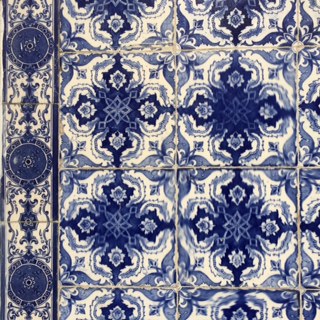
Portugal is committed to handsome tile work and other architectural statements reflecting the Moorish occupation of the Iberian Peninsula for over four decades. Artistic tile work is common. I have not known seeing the same design twice! One building in Vilafranca was faced entirely in tile. If you can’t make out the sign above the blue doors, it sports the hammer and cicle and the initials PCP. Posters with their demands are common hereabouts.

The next day on the (asphalt) trail, I rested at a bus shelter and captured the advertisements that flanked the bench.

A Big Mack will cost you € 5.00, fries and a coke are extra. The blouse is € 19.99. Both prices include the VAT.

The plaza at twilight before the Municipal Building in Vilafranca and the Plaza in front of its railroad station. Vilafranca is proud of its bullfighters and that it is an important location for training bulls for the ring. Likenesses of famous bull fighters from Vilafranca adorn the walls of cafes and bars.

On the road from Azambuja to Santarem.

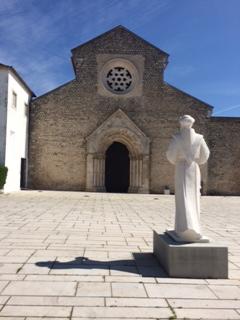
Santarem is a lovely small city with many historic churches and fortifications. The old town commands a 360 degree view of the surrounding countryside. A consideration not lost on Julius Caesar, who designated it as his regional administrative headquarters. Two views of Sao Francis de Assis and the convent, and church that bear his name:

Yesterday was a recovery day for me. The blog received considerable attention but was completed today after completing the first leg of my next trek north on the Camino. I’ll write about that in the next blog entry.

With that, I´m off.

Knute Michael

Fog City Boy #3.1 (Republished)

Fog City Boy on the Camino Portugués

Lisbon, Portugal – April 1, 2014

The transit from San Francisco to Lisbon was pleasant enough. Virgin Atlantic and TAP (the Portuguese airline) did everything they could to make airline travel what it used to be! Both flights met my definition of "good flights." In my lexicon, "good flight" translates as "uneventful."

When I arrived at Lisbon, I cleared immigration and customs quickly, found a cambio and exchanged USD 50 for € 28 and change. The 10 percent commission charged by the cambio (this in addition to the spread on the transaction) was exorbitant but I accepted it as a necessary evil. I didn’t want to get caught without at least a few euros in my pocket until I could find an ATM that would provide exchange at a more reasonable rate. And a good thing, too. The kiosk at the entrance to the Lisbon Metro would not accept a charge to my US issued charge or debit cards because neither sports a smart chip that is universal now with European issued cards. Most businesses and ATMs still accept the US based swipe card technology, but kiosks don’t. I understand that US banks and card issuers will go to smart chip technology within the next 48 months. So, using some of my euros, I bought a transit pass and loaded it with € 10 to get me into town and around town for the next couple of days.

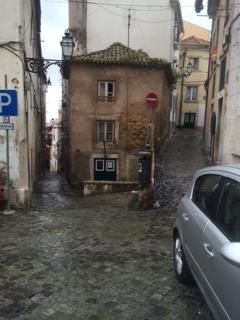
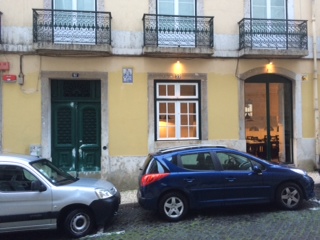
The Metro got me to Santa Apolonia Station swiftly enough. It was late afternoon and I walked the short distance to my pension through a charming section of Old Lisbon, a rabbits’ warren of streets, alleys, stairways, and passages. The last image is the entrance to my pension (on the left).

I checked in at the pension and was taken to my room, small but comfortable, with a clean bed, a shower and a sink to myself. Other needs were met down the hall. The building was certainly over 100 years old and was built before electricity and other amenties were commonplace. Water pipes poked through the ceiling and after serving my sink and shower continued through an adjacent wall to serve another room. A perfectly satisfactory, even elegant, setting for a peregrino to begin his Camino!

I flopped down, showing the signs of sleep deficit and transmeridian travel – aka jetlag. In due course, I got up and wandered outside. I found an ATM that happily vended me € 200 and tapped my bank account back home. It was Saturday evening and I wandered the central part of the old city. There were many folks – old and young – out enjoying the evening. There was a bit of rain, but nothing troubling. Many broad plazas and streets that had been turned into nicely paved "malls" sported outdoor cafes. I wandered back toward my pension and found an inviting restaurant that featured fish for dinner (essentially all restaurants in Lisbon feature fish all day) but it also had live entertainment. A guitarist, a fellow playing what I take to be an early form of mandolin, and a middle aged woman who sang Portuguese songs with gusto. She didn’t need a microphone to fill the room! The food and the entertainment were good, and appreciated by the crowd.

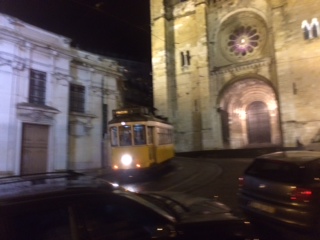
The next day I rode one of the little yelow trams that are the Lisbon equivalent of cable cars in San Francisco. The traditional trams are single-truck and very narrow guage. They ascend and descend the hills of this very hilly city at high speed. They don’t slow much for blind intersections. They are crowded at all times and a fun experience. Lisbon gift shops all carry a supply of models, drawings, and figurines celebrating the little yellow trams.

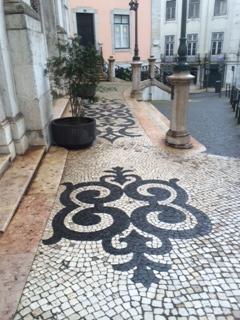
In the old part of Lisbon, streets and sidewalks are made of cobble stone. Often with interesting designs in black and white stone.

Because Portugal and Spain were neutral during World War II, many historic structures remain to be enjoyed today.

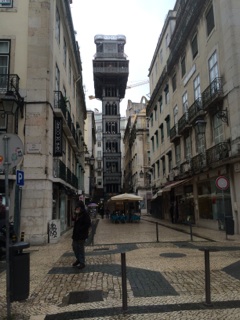
Again, Lisbon is a city of hills. Entrepreneurs built elevators to service the hill climbing and hill descending population charging more to ride up than the fare to ride down! Here’s a famous one built early in the 20th century. There is an observation deck at the top. I rode it up for a normal fare on my metro card. (The elevators are reminiscent of the esclators Ginna and I found in Hong Kong several years ago – serving the same purpose for the populace, though using different technology, and for free!)

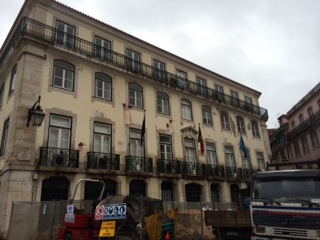
The people seem busy and happy and quite fit, though there are signs of discontent with the economy and the austerity measures demanded by Portugal’s EU partners. Graffiti is ubiquitous and even more common than in San Francisco. Most is simply in the form of individual tagging and thus quite oppressive, but some carries a political message. Here’s a government office building that has been pelted by bags of red paint, reflecting some of the discontent.

I have had a good time in Lisbon and am ready to set out on my Camino in an hour or so, after posting this chapter to the blog. Not all the experiences in Lisbon have been positive, though. I was pickpocketed on one of the trams on Sunday and spent part of Monday cancelling a credit card and a debit card. Fortunately, my passport was in the safe at the pension, and I have a standby debit and a standby credit card that will get me through until the replacements arrive. I bought a new sim card for my cell phone which gets be connected to the web – that’s the good news. The other news is that calls to and from the US cost € 0.60 per minute (that’s about 78 cents per minute). I’ve instructed my family not to call to tell me they love me. Just think good thoughts!

And it has rained every day, not alot though, until yesterday. And there was a robust thunderstorm last night. But, hey, I haven’t melted yet. And I have a poncho to protect me and my backpack.

And then there was the couple next door to me in the pension. An older couple and no doubt quite deaf. They spoke loudly to each other, and through the thin wall, to me. They talked all night long (or at least until 3 a.m. on Sunday night). I didn’t go to sleep until 5 a.m. and then slept only until 10:30. The same had been true on Saturday night, though they knocked off early – about 1:00 a.m. Yesterday I asked for a different room and the house responded graciously. I slept well last night.

Part of the pilgrimage is encountering adversity, accepting it, and continuing on the journey. Row all the way to the finish.

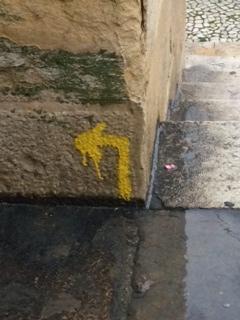
Here are pictures of the Lisbon Cathedral Se, the starting point for my Camino. Last night I asked a passer by to take my picture standing by the first way mark on the Camino Portugues. It is rather unobtrusive, So I have included a closeup.

As soon as I post to the blog, I will head to the Cathedral to get the first stamp on my Credencial del Pregrino.

With that, I’m off!

Knute Michael

Fog City Boy #2


Fog City Boy on the Camino Portugués

San Francisco, California – March 28, 2014

Today is the big day. I leave for Lisbon from SFO (by way of London Heathrow) in just a few hours. I’ll arrive there about 4:00 pm tomorrow local time and then make my way to the small pension not far from the Cathedral from which I will begin my Camino three days later. (35 euros per night gets me my own room with a bathroom and shower! Does it get any better than that?)

And so it begins.

The question arises for all peregrinos, “When did you actually begin your Camino?” In my case, the practical answer is that I will begin the Camino when I get the first stamp in my Credencial del Peregrino (the pilgrim’s passport) at the Lisboa Cathedral Se and take the first step on the 613 kilometer Way to Santiago. [I am training myself to think in kilometers rather than miles.]

But as our daughter who has walked the Camino wisely observed, you begin your Camino when you form the intention to do so. That is when the spiritual journey begins.

Thus, my Camino begins Tuesday next, but also began about one year ago.

I had mulled the idea of walking the Camino ever since we met Elizabeth in Santiago at the conclusion of her Camino in 2010. We heard the many stories of her experiences. I was intrigued, but could not imagine breaking away from my duties as a member and president of the California Board of Pilot Commissioners to take a lengthy hike. But, on March 1, 2013 I was termed out and by statute could not be reappointed. That freed me to consider undertakings of greater duration than had been possible for the previous eight years. Shortly after that, I determined to walk the Camino.

Preparing for the Camino has been a journey in itself. Part physical, part intellectual, part practical.

I have done a fair amount of walking, with my pack and in proper hiking shoes. I have kept up my aerobics regimen. Not as much as I had intended, though.

I read a history of Portugal and surfed the web a lot. And I enrolled in a beginning Spanish class at San Francisco City College. I was not able to finish the semester, of course, the Camino holding sway. But the weeks I spent in that class will prove invaluable on my Camino. Muchas, muchas gracias, Profesora Babylon.

And I have collected all the stuff that I think I will need. A trip to REI is great fun!

imagenimagen

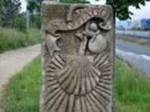
The scallop shell – la concha – is the best known symbol of El Camino de Santiago – the Way of St. James. The striations on the surface of the shell begin at various points on the periphery but converge at a single point – as do the several Camino ways. Some begin at multiple origins in Spain and Portugal. Others begin in France, Germany, Italy, and elsewhere in Europe. But all the Caminos end in exactly the same place – the plaza before the Cathedral in Santiago de Compostela in Spain.

imagenimagenimagen

There are other symbols of the Camino. The yellow arrow as a way marker along the chosen route. The Cross of Santiago which can be traced to the time of the Crusades. And thebotafumeiro in the Cathedral of Santiago. At a pilgrim mass held on Friday evenings at 7:30, the botafumeiro is swung across the transept, high above the congregants and dispenses incense that permeates the Cathedral. For the peregrinos who have just completed their Camino, the incense wafts around them, signifying an embrace, welcome, and blessings.

In 2011, Ginna and I traveled to France, Norway, and Russia. While taking a hike from Viriville in France (about half way between Lyon and Grenoble), I came upon the way marker below. Apparently the Camino in question led down the stone steps out of the picture to the left. The way marker instructs peregrinos to continue to the right up the country lane. At the crest of the hill is a church and an alberque.

I am encouraged to find that a Camino runs through that part of the world because certain old salts of my acquaintance, when engaged in ship handling training at a nearby lake, might consider jumping ship and setting out on a Camino of their own. From Viriville, it is only 1400 kilometers to Santiago. It can be walked in 291 hours. . . if you don’t stop.

So now, as I embark on a wholly new experience, I think about how best to relate to a new challenge, a physical, endurance challenge. This won’t be a sprint. I don’t do sprints. I don’t have the explosiveness to do sprints. This is an endurance challenge. And, I’m fine with that.

But, how to relate to the physical challenge? To the mental challenge? And the spiritual overlay?

Jim is with me. I recall his training me for the Peninsula Indoor Rowing Championships (PIRC) several years ago (a 2000 meter rowing time trial). On the last day of the training, three days before the event, I asked him, “when I am sitting on the erg, waiting for the starting horn, what should I be thinking about?”

“Gratitude,” he responded.

Yes. Gratitude. It worked for me at the PIRC. I didn’t bring home any metal, and didn’t expect to. What I did bring home was a new PR – a new personal record. And memories of the experience.

So now, as I ready my pack, and prepare to leave for SFO and the adventures that will follow, I think about gratitude. Gratitude that I am strong enough to undertake this journey. Gratitude for family and so many friends who have supported me in this quest. Gratitude to have the opportunity to walk the Camino.

With that, I’m off.

Knute Michael

camino-preparation-part5-caminoways

Fog City Boy #1

Fog City Boy on the Camino Portugués

San Francisco, California – March 18, 2014

Thank you for visiting my blog. I hope you will return to it follow my progress on the Camino de Santiago de Compostela (Portugués)!

I depart San Francisco on Friday, March 28th. I will fly to London and then on to Lisbon. The total travel time will be about 34 hours. I have a room reserved in a small pension in Lisbon, near the river and in the historic district. I will spend three nights and two days there, recovering from jet lag (aka transmeridian travel). And then on March 32nd (I have been cautioned not to tell people I am starting a 400 mile hike on April 1st), I’ll be off.

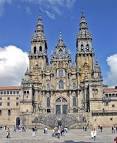
The Camino is a pilgrimage that many thousands of people from all over the world have made. There are many routes with waymarkers in stone, or simply painted yellow arrows, starting in different locations, but all ending in exactly the same place: The plaza in front of the Cathedral de Santiago in Santiago, Spain.

Most peregrinos (pilgrims) walk the Camino Francés, usually starting in St. Jean Pied de Port in southwest France, as did our daughter, Elizabeth, in May, 2010. That route is 500 miles. She did it in 35 days. I am planning to do my 400 mile pilgrimage in 45 days, more or less. (Elizabeth is somewhat younger than I.) I will stay in the albergues (pilgrim hostels) where they are available and in inexpensive lodging when not. I’m packing two changes of clothes (one on my back, the other in the pack), three sets of underwear, four pairs of socks, two pairs of shoes (one to walk in and one to walk about in after arriving at the day’s destination) and assorted other impedimenta – all of which will be useful, but all of which weigh something. I will do my laundry nightly in a sink wherever I am staying – usually washing with shampoo. It will dry overnight. My pack and contents will weigh no more than 17 pounds – 10 percent of my body weight.

Peregrinos undertake the Camino de Santiago (the Way of St. James) for differing reasons. Many do so for religious reasons. The Camino de Santiago is often thought to be the most important pilgrimage in the Roman Catholic communion. Others undertake it for other spiritual reasons. And many do it for the sightseeing it offers.

My motivations are a mixture of the latter two reasons. I enjoyed riding my motorcycle through Spain and Portugal some 48 years ago and wanted to go back and see more of those countries again. But there are other reasons, reasons that are related to an athletic, physical, and spiritual journey I have experienced over the last seven plus years. Without too much elaboration, suffice it to say that upon returning to my native San Francisco from Washington, D.C. in 2004, I discovered that I had gained an uncomfortable number of pounds and I decided to do something about it. I got into a program that was quite holistic, involving strenuous but enjoyable exercise based on an athletic training model, combined with nutritional counseling and behavior modification counseling.

I am pleased to report that in 11 months I lost over 10 percent of my bodyweight (net of increased musculature) and have kept it off. But there is another aspect to the program as I and others experienced it. There was a philosophical element, indeed a spiritual element, with which our trainer imbued us. And that spiritual element will be an important part of my Camino.

Our trainer’s name was Jim. He’s not with us here on earth now. But there is good reason to believe that he is in heaven – training the angels and the cherubs to ride celestial double centuries and row 2Ks and marathon rows on the erg – the indoor rowing machine. (My friend Bob would dispute the latter report. He believes that ergs only exist in the other place, where they were invented to train the boatmen who rowed the unfortunates across the River Styx. But no matter.) Jim will be with me on my Camino.

You can learn more about the Camino de Santiago by searching on that name on your search engine of choice. You will get many thousands of hits. Martin Sheen made a very good movie about the Camino called “The Way.” I commend it to you. A good and funny book about the Camino is “I’m Off Then” by Hape Kerkeling. Also, there is a recent and good documentary showing in theatres from time to time called “Walking the Camino: Six Ways to Santiago.”

As I write this, I am 10 days from getting on the big bird and heading off to the Camino. I’ll post again on March 28th before I head to SFO. Hope to see you here! If you wish, you can toggle on and my posts will be sent directly to your email when I click on “publish.”

With that, I’m off.

Knute Michael

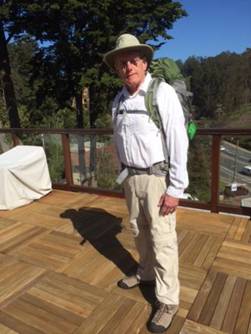
Fog City Boy showing off his backpack stance!

Fog City Boy on the Camino del Norte