Fog City Boy #15

Fog City Boy on the Camino Frances

Leon, Spain – April 29, 2015

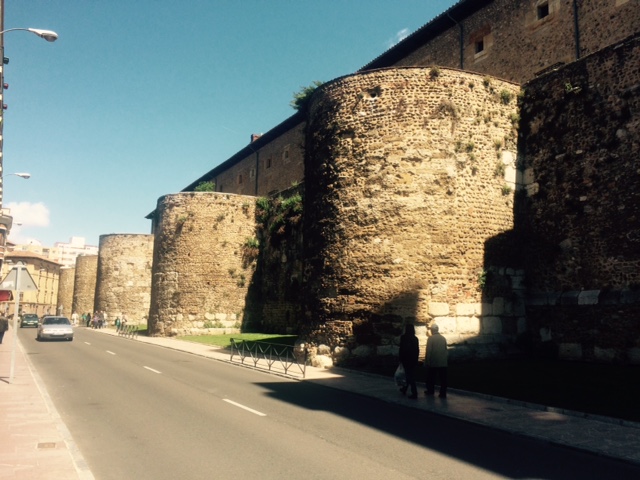
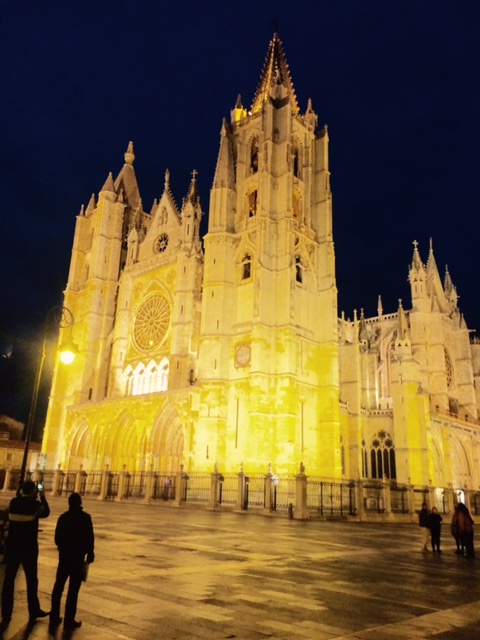
Leon is a beautiful city with a long history. Many parts of the stone walls that were built to defend this ancient city still stand.

fullsizerender150

It is the capital of the autonomous region of Castilla y Leon and is home to 130,000 souls. There are may grand buildings – the grandest, of course, the Cathedral de Santa Maria de Leon.

fullsizerender131

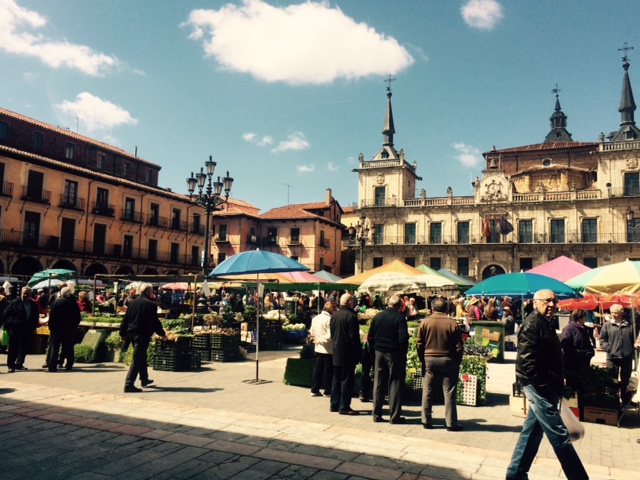
Not far away is the Plaza Mayor with its own grand buildings. And, on the morning after my arrival, a farmers’ market that was well patronized.

fullsizerender148

fullsizerender149

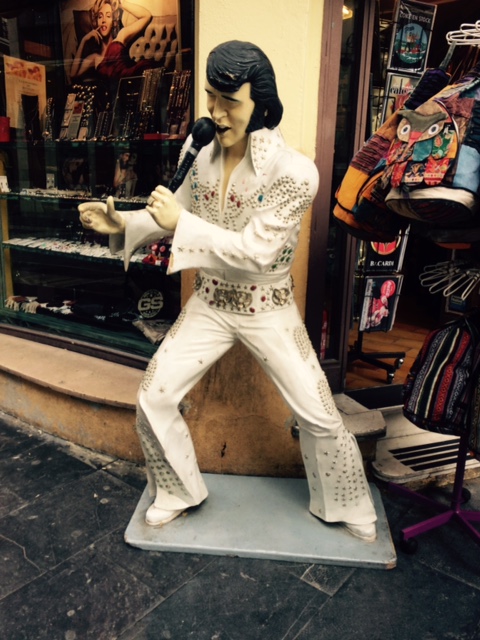
However, modern mercantile cannot forsake the influence of American culture.

fullsizerender129

Castilla y Leon has nine provinces, three of which are host to The Way – Burgos, Palencia, and Leon.  An obliging peregrino captured a picture of me crossing from the Burgos province into Palencia.

fullsizerender101


The great Meseta plains occupy much of these three provinces, and The Way makes its “way” through them.  A vast agricultural region located between 1000 and 3000 meters in elevation, it is home to many cereal crops providing broad expanses of green scenery for the peregrinos who pass through it.

fullsizerender111

The Camino is about many things, including geographical obstacles that challenge any peregrino.  One is encountered about two kilometers beyond Castrojeriz where I had overnighted. The placid countryside abruptly produced a mountain! Actually, not a mountain, but rather a climb up to a broad rocky plain with this year’s crop successfully rooted and flourishing. Here’s the advisory to vehicles and peregrinos beginning the climb . . . .

fullsizerender106

I considered the best mental approach to this challenge. For shorter climbs, I have used the device of counting my steps or counting pole clicks as I swing my walking sticks for balance and stability. I have used this techniques (counting breaths, not pole clicks) while doing long planks ata the gym. It helps keep extraneous thoughts at bay (like “whennnnn is this gonna stop?)

This time, I thought to employ the state of “no-mind,” a much more powerful, if somewhat illusive, tool to get through an extended physical challenge. It involves clearing the mind of all thoughts.

It worked. I made it to the top of the grade in 20 minutes. And it seemed like a much shorter time.

Thank you, Jim.

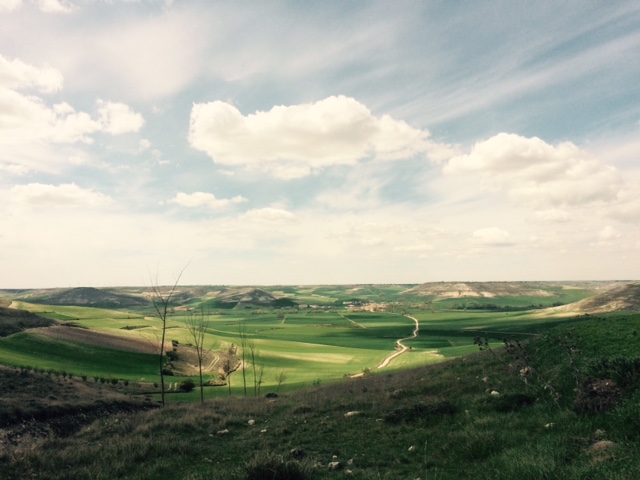
There is a monument and an area de descanso at the top of the grade.  The view of the valley from which the peregrino just climbed is extraordinary and my camera does not do it justice, but here’s my best shot.

fullsizerender89

Although a long day on The Way is certainly a physical challenge, we encountered a noteworthy mental challenge a couple of days later (and continuing for several days more). The challenge? Boredom.

Once dropping down from the Meseta, the Way shifts to an extended succession of sendas that run immediately adjacent to secondary and sometimes primary roadways. All peregrinos in my cohort of travelers agreed. Boring!

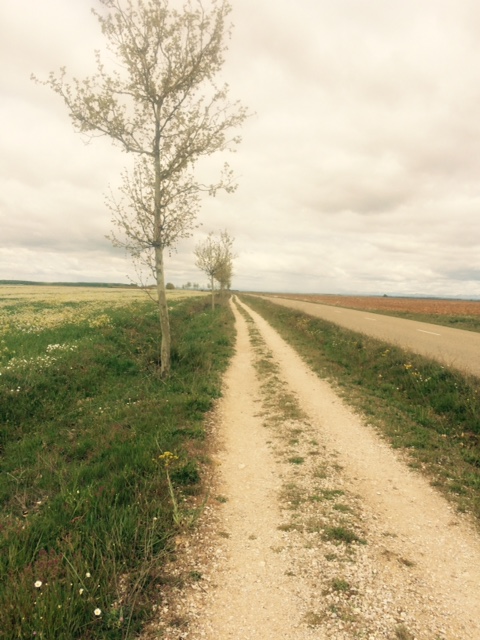
Senda translates as “pathway.” They are of relatively recent construction – say the last 10 years. They are paved with sand and gravel and good drainage is part of the design. And if the roadway goes straight without a bend for 10 clicks, so does the senda. If the roadway does not encounter a town or a monument, neither does the senda. Peregrinos have been spoiled, it would seem, with discoveries along the way to break up a day’s hike. Not so, now that the sendas are the way forward. Rumor, and a plausible one, is that the several governments through which the Way passes built the sendas because of the tragic numbers of peregrinos who died walking on the often busy highways that often made up long stretches of the Way until the sendas were built.

fullsizerender146

Happily, not all of the Way from Burgos followed paved roadways. For about 4 kilometers, the Way traverses one of the towpaths of the 18th Century Canal de Castilla – originally both a source of agricultural irrigation and transportation (hence the towpath), as well as a source of power to turn the mills that ground the corn grown in the region in times gone by. Today its use is irrigation and some recreational boating.

fullsizerender97

The system of locks is in disrepair and disuse. There are plans to rebuild the 50 locks, but I fear they will be on hold as long as Spain’s economic woes continue.

fullsizerender98

With that as a segway, I will make an observation concerning the economic woes and what I speculate are long-term demographic changes that Spain has experienced in recent years. The Way passes through dozens of small towns – populations estimated variously from 70 to a few hundred. And in almost all of these towns there are dozens of residences the fascades of which are well kept, but shuttered, and with no autos parked nearby, suggesting that they are unoccupied and have been for a time.

I think what has happened is the same thing that happened in Collinsville, Texas, my late father’s hometown, some 50 or 60 years ago. The towns, Collinsville and in Spain, were built to support the agricultural activities in the vicinity. But today, sadly, there is no need for these towns to service that activity. Industrialized agriculture means that “Dad and one son” can do the work that previously took the labor of many families.

So. . . the young people leave for the city. The family home stands vacant because there is no market for these houses in a town with no jobs, and too distant from employment to retain a viable population.

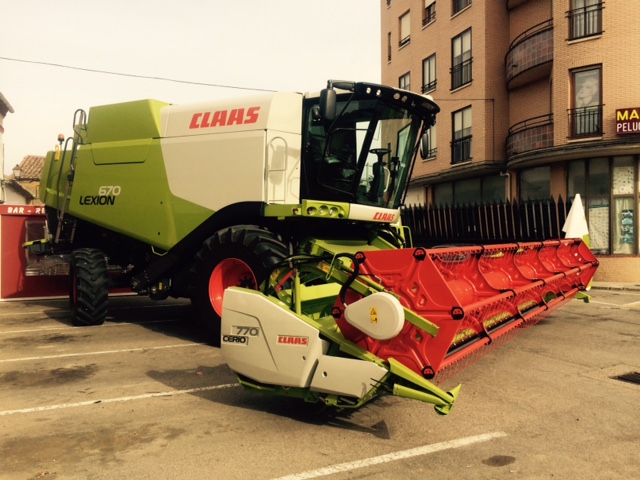
The Way passes through Carrion de los Condes where last weekend there was a major agricultural fair. Call it a localized trade show with tractors bigger than anything I have seen before!

fullsizerender127
f

Peregrinos have inspired communities and artists for many years, and it seems that tributes to peregrinos are increasing in number as the Way wends its way ever closer to Santiago. Here is a sampling. . . .

fullsizerender119


fullsizerender112


fullsizerender94

fullsizerender136

fullsizerender135

fullsizerender133

fullsizerender134

A few days ago, just before arriving at Terradillos de los Templarios, an ancient Knights Templar stronghold, the cohort of peregrinos in tandem with whom I am walking crossed the halfway point from St. Jean Pied de Port to Santiago! Everyone was quite pleased (and a bit self-congratulatory).  It seemed then as if we hadn’t really come far enough to be half way.  But I think we all accepted the statistic as pleasing and reassuring!

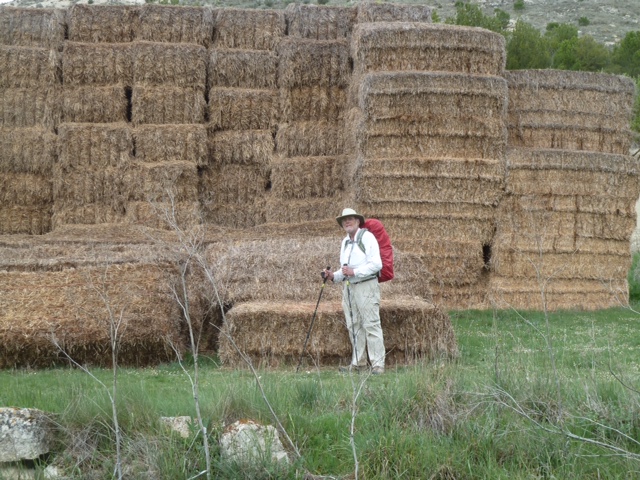
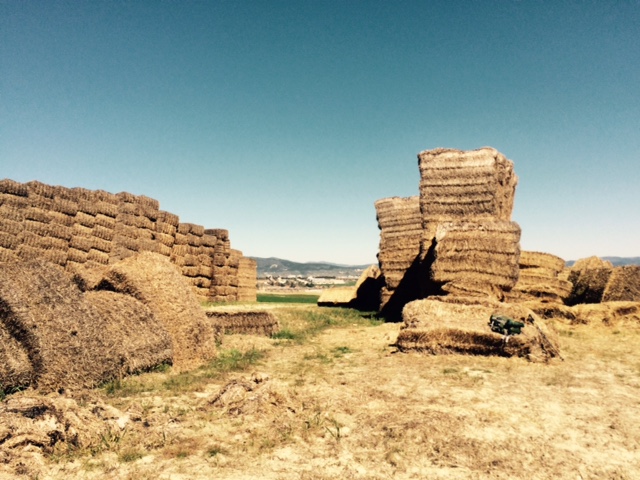
I have mentioned the “cohort” with whom I am walking. This is not a “Camino family” or an organized group of peregrinos – simply an assortment of peregrinos who find themselves on The Way at the same time and more or less in the same places from day to day. We have had conversations and shared laughs.  And occasionally snapped pictures of each other.  Here’s one of Fog City Boy posing resolutely by a hay bale in San Anton, followed by one of the Boy happily taking a break.

image1

image2

I’ll name a few names! Linda from Vancouver (the hay bale photographer). Remy from Holland and Claudia from Cuba/Spain/Miami. Jack from Holland. Julia from Sweden. (Julia bears a striking resemblance to a girl of Swedish descent with whom I attended 7th through 12th grades back home in San Francisco. Julia is charming, articulate, and is completing her studies in pharmacy in Gotheburg.) Katherine and Dana from an island in Puget Sound, who have already one on ahead. Paulette from Vancouver Island. Manuel from Bavaria. They have gone on ahead by now. The two French girls and French Canadian guy I have urged to “rock and roll” on their Camino. (Credit to A.J. for that one.) Two young German peregrinos – Flo and A.K. Michael from Newcastle. Jenny from New Zealand. Both have gone on ahead. And a remarkable trio. . . . With 9-month-old Valentina in the lead, Mom and Dad walking the Camino starting in Burgos. The family hails from a town near Stuttgart.

fullsizerender113

fullsizerender114

I saw them yesterday here in Leon, likely for the last time. Today, they have gone on ahead while I take a recovery day and post to the Blog. They hope to go on from Santiago to Finesterre, as do several other members of the cohort.

There are others who should be listed with the cohort, above. Be assured, I haven’t forgotten you.

It is the nature of the Camino that the peregrino meets many others and – for those who get the reference, just like in PMAX,  one gets to know the others in a deep but very focused way because of the shared challenges and shared experiences. Several peregrinos have mentioned to me that the Camino experience is like none other they have ever had. The ability to speak immediately to other peregrinos about the Way, their experiences there, and even issues in their lives – these are new and important experiences for them.

I think the Camino gives the peregrino permission to trust others on the Way and those along the Way who respect and cater to the needs of the peregrinos. A special thing.

Sitting at a cafe along a major street in the old town last evening here in Leon, I was found by Jack from Holland and Julia from Sweden. We agreed to have dinner and, searching for a suitable pilgrim menu came upon two Italian peregrinos known to Jack and Julia, but not to me. No matter! We all are peregrinos, after all. We had a delightful dinner together. And with that, I will close. The Italians are in the forefront, Julia on my left, and Jack on my right.

fullsizerender130

I’ll post again (hopefully – depending on the availability of a computadora) before I reach Santiago.

With that, I’m off!


Knute Michael

camino pix

Fog City Boy #14

Fog City Boy on the Camino Frances

Burgos, Spain – April 21, 2015

Burgos is a busy, bustling city, and quite astonishing after spending parts of six days walking through the rural countryside of Spain. It is good to be in a big town for a change and to be able to access the internet – having finally been able to publish FCB #13 and compose this FCB #14.

But before sharing images of quite a remarkable cathedral, I´ll share some images and thoughts about the Way from Logroño to Burgos.

The Way from Logroño traverses an extended city or regional system of parks. The Way through the parks is paved but access is limited to those who go by foot or by bicycle. The author of the guidebook used by almost all English speaking/reading peregrinos grouses about the paved Way, but for me, it was a relief. The open trails and track of the Camino generally are studded with embedded or loose rocks of varying sizes and difficulty. (And furthermore, my boots that served so well in Portugal last year, and have served well to this point in Spain, are starting to fall apart!  Yikes!)

While the scenery adjacent to these tracks is beautiful, a wise peregrino is staring at the Way so as not to trip or turn his ankle! There was a dirt trail adjacent to the paved Way for peregrinos who preferred the more traditional footpath.

Emerging from the park system, I passed a young olive orchard, graced with wildflowers, and began a climb that eventually brought me to Navarrete, another town that welcomes peregrinos.

fullsizerender45

fullsizerender46fullsizerender57

I continued on to Ventosa where I spent a comfortable night in a Casa Rural. There was no food service in this small hotel, but peregrinos (most spending the night in an albuerque in town) gathered at a local cafe and enjoyed the menu del peregrino – three courses including wine, water and bread, for €10. I joined a table that included a 74-year-old lady from Vancouver Island in British Columbia, a young Bavarian fellow, and a recently retired American woman from Seattle. At desert, I invited a an older gent from Finland to join us. Good conversation followed. We repared to our respective lodgings.

I was up early the next morning and out on the Way. I passed a curious structure as I neared Najera. I have not learned its purpose or its history.

fullsizerender58fullsizerender59

The Way through Najera winds through the old town and then climbs steeply before settling into pleasant framland. A series of handsome waymarks placed by the government of La Rioja keep the peregrino informed of progress from kilometer to kilometer.

fullsizerender61

Unfortunately, many have been relieved of their conchas and/or distance plaques by peregrinos or others who took them as souveneirs. Some passersby simply complained about the statistical information provided, and apparently removed it out of spite.

My energy level this day was good, and I reasoned that at 1400, it was too early to overnight, so I continued on the last leg of the day, from Azofra to Cirueña, a distance of 9.1 additional killometers. There was weather along the way that afternoon. Not a downpour, but sprinkles and mist along the way. The town is emblematic of the economic problems Spain confronts. The town is essentially a newly built suburb of Santo Domingo de la Calzada, the next town of substance along the Way. Row after row of newly built housing blocks stand vacant and signs of “vende se” are on every street. There was a nicely manicured 9-hole golf course, but no golfers.

All in, all done, the day was a 16.5 mile day for me and I was tired but I felt ok. When I checked in at the Alberque Victoria, a welcoming glass of vino tinto provided by the hospitalero certainly helped. The next morning, however, I felt it! Vino or no!

There were eight other peregrinos there (one from an adjacent Casa Rural operated by the same folks who run the alberque). All nine of us enjoyed the menu that night. The Finnish guy and the Bavarian from the night before were there, as were two Dutchmen, a Swede, a woman from Japan, another American and another German woman.

After dinner, which of course included wine, we had another bottle of wine. And then another. The conversations were spirited, needless to say. And cordial. The big take-away for me was the unanimous concern voiced by the Europeans about the recent Russian adventurism on the borders of Central and Eastern Europe. The fellow from Finland mentioned a recent military alliance with Sweden that was unprecedented but that both countries felt necessary in light of the Russian military presence not faraway.  And the unpredictability of its leadership.

On a less harrowing note, the Swede provided me with something that all my life to that point I had not known: “Knut” (the proper spelling of Knute) is a very old Swedish name that literally translates as “knot.” He observed that many old Swedish names have a common language meaning in addition to serving as given names. Well there you go! It´s taken 70 years, but now I know!

I could go on about the days between Cirueña and Burgos, but I will spare the gentle reader all that detail. Here are a few highlights:

I arrived in Viloria de la Rioja (having crossed from La Rioja to the state of Castilla y Leon) and stayed at a Casa Rural named MiHotelito run by a delightful Basque woman who reported on the progress of her adult children and goings on about town. She was not able to offer dinner and there were neither restaurants nor cafes in that small town. I made my way the small Alberque Acacio y Orietta that sleeps just 10 peregrinos. They were sold out that evening, but took me in for a family style meal of green salad, rice, lentil stew, and ice cream for desert. The hospitaleros (Acacio and Orietta) asked to go around the table with each guest giving their name and where they were from and why they were on the Camino. When it came to my turn, I told them of the physical challenge – the endurance challenge – that was at the center of my peregrenacion. I spoke to the confluence of body, mind, and spirit. My sentiment was well received.

Thank you Jim.

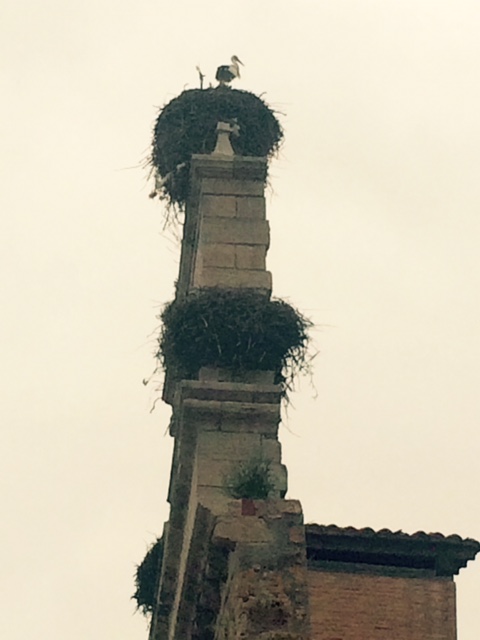
In Belorado, the Way passes by the Iglesia de Santa Maria y San Pedro. The belltower is home to four storks´nests and at least one stork!

fullsizerender64

fullsizerender63

And nearby is a wonderful mural commerating the success of Alfonso the Brave in battle nearby.  An advertisemet seeking the attention of passing peregrinos was not added by the artist.

fullsizerender65

The trek from Villafranca Montes de Oca (altitude 950 meters to the second summit reached on the climb – 1120 meters) literally started at the backdoor of the Hotel San Anton Abad which also included a substantial alberque under the same roof and management. The two peaks are separated by a narrow valley formed by the Aroyo Peroja. Here are two views of the Way at that point.

Going down:

fullsizerender70

And having crossed the Aroyo on a small woodplank bridge, come up the other side!

fullsizerender71

Spain appears to have made good use of renewable energy, and to be sure, there are regular gusts of wind at the crests of the hills across the plains.  Windmills have accompanied me along the Way.

fullsizerender72

A day later, on the last (quite chilly) segment of the Way before reaching Burgos, the Camino traversed a Roman road, eventually reaching a summit shrouded in mist. A reminder of the faith stood out in the mist. A bit further, devoted supporters of the Camino have constructed a waymark from stones collected nearby.

fullsizerender75

fullsizerender77

fullsizerender76

Burgos is a city serving as a government center with many substantial buildings.  The most dramatic, of course, are the churches.

The  Way takes the peregrino into the old city through the Arco San Juan.

fullsizerender84

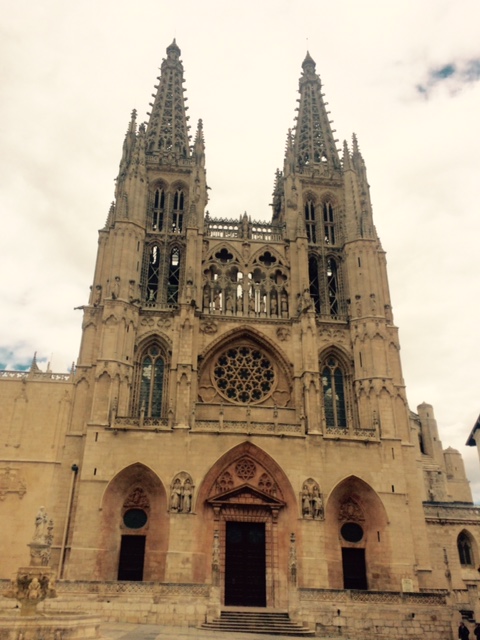
The Way eventually arrives at the Cathedral of Burgos which is spectacular, to be sure.

fullsizerender81

fullsizerender82

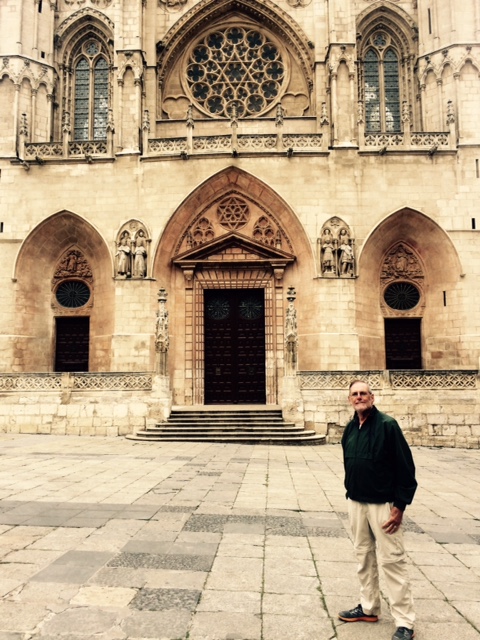
I ran into the Baverian fellow and the Canadian lady who graciously memorialized my presence there.

fullsizerender83

I took a tour of the Cathedral and stood in awe of the majesty of the structure and the extraordinary collection of religious art that graces it.

Today is a recovery (and blogging) day for me. I´ll be up early tomorrow (the 21st), and continue along the Way. I´ll post again in a few days.

With that, I´m off.

Knute Michael

camino pix

Fog City Boy #13

Fog City Boy on the Camino Frances

Logroño, Spain – April 14, 2015

[Ed. Note – I continue to have difficulties including photos with the text of my blog entries, thus the delay in publishing this post – datelined Logroño, April 14th.  I have encountered a challenge not found on The Way last year, to wit, the habitaciones where I have been staying either don`t have internet access, have it but don`t make it available to guests, or don`t support it with recent software updates.  I think the difference between this year in Spain and last year in Portugal is two-fold:  Time marches on and more and more travelers are bringing devices that connect with the web using wifi (available at every hotel, alberque, and bar in Spain), and the economy of Spain is better than last year`s economy in Portugal.  Fewer folks want access to the web using a PC and so the hospitality industry locally doesn´t spend the time, energy, and money to provide it.  Local libraries do, however, and that`s where I`m generally able to polish and publish.  With that preamble . . . .]

Pamplona is a delightful city with a strong Basque heritage and an all encompassing enthusiasm for all-things-Basque and all-things-partying. It is quite endearing. The days I spent there (one and one-half more than planned) were enjoyable if frustrating because of the electronic challenges I faced – both in terms of acquiring a working SIM card for my iPhone, and the ongoing struggle to upload photos to this blog. Fortunately, those difficulties largely have been surmounted.

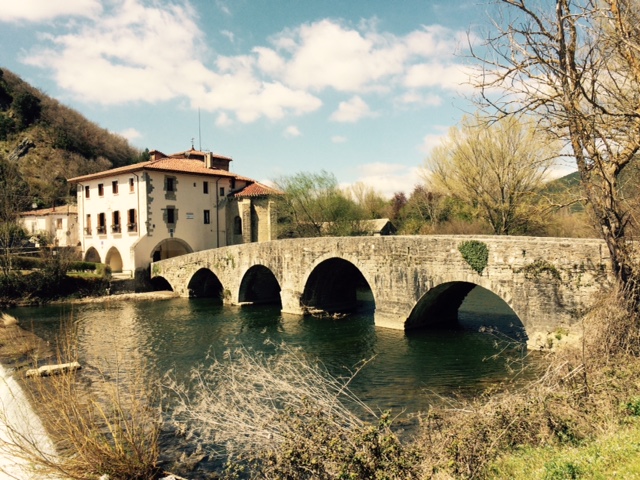
Here´s a lovely bridge I crossed when approaching the city center.

fullsizerender39

Without dwelling excessively on those challenges, I will simply report that the Way from Pamplona traverses city streets that are well way-marked leaving little opportunity to get lost – in contradistinction to my experiences in the early days of the Camino Portugues. The Way passes directly by the Public University of Navarra which invites peregrinos to enter the campus and get a stamp (“sello”) on their pilgrim passports (“credenciales”) – an “accreditation” attesting to their peregrenaciones at this point. Not a sheepskin, but a valued acknowledgment of commitment that embraces body, mind, and spirit.

Thank you, Jim.

The day was clear and pleasant. Perfect weather to commence the next stage on the Way.

Because of the late start, I only reached the small suburban town of Zizur Maior (its Basque name). The next day saw me taking a bus back to Pamplona to work again with the Vodafone folks who eventually, using trial and error, got my iPhone to receive and transmit data. Bravo. But half the day was gone by the time I finally returned to Zizur Maior, retrieved my backpack, and set out on another short day. The Way passes stacks of hay bales reminiscent of scenes from Martin Sheen´s movie, The Way.

fullsizerender9

And further along, the Way passes the ruins of the Guendulain palace dating from the 16th century.

fullsizerender11
fullsizerender11

Eventually, the Way brought me to Zariquiegui, a small village on a hilltop amid verdant fields. A tour of the town took seven minutes, but the views were spectacular.

fullsizerender12

I checked in to Alberque San Andres, a clean and welcoming facility. I shared an 8-bed (four bunk bed) room with a Swiss lady of about my age, a young Spanish mobile-app developer between gigs, and a delightful young lady from Taiwan whose English was impecable. In the adjoining room were three other peregrinos with whom I would walk in tandem for the next several days – an architect from Newcastle, England, his nephew who was walking a bit of the Camino in anticipation of his wedding a few days later, and an educator from New Zealand who had just completed her service as the principal of an international elementary school in Germany. Though we did not become a “Camino family,” we did hang out together, along with others who formed kind of a loose cohort of peregrinos all headed along the Way at the same time.

My friends have since continued on beyond Logroño while I have lagged behind to enjoy a recovery day and to post to the blog. I hope to catch up with them. We have become good friends in just a few days on the Camino. Such is the nature of the Camino.

The climb out of Zariguiegui the next day was steep and windy. No doubt a consideration in the placement of the windmills on the ridge! A sculpture honoring peregrinos graces the crest of the mountain.

fullsizerender1

fullsizerender3

Later that morning, I decided to pursue an alternate route along the way to visit Santa Maria, a small church in Eunate (near Obanos).  It is Romanesque and octagonal in design, built in the 12th century.

fullsizerender6

fullsizerender7

The church was not yet open when I arrived. I stretched out on a bench and took a brief nap. When I awoke, I discovered that a peregrina from South America had also arrived. She kindly offered to share the bread and cheese that she had had the foresight to bring with her (it now was well past midday). I accepted with thanks.

I set out to explore the grounds and eventually returned to the door to the sanctuary which by then had been opened by the warden. My fellow pilgrim was on her hands and knees before the alter in a supplication and prayer. I waited respectfully. In time she arose, overwhelmed with emotion, and tears in her eyes. I offered a hug. She accepted.

fullsizerender8

The sanctuary is small and only dimly lit. Recordings of Gregorian chants enhance the experience which encourages contemplation and prayer.

That evening she and I found ourselves at the same table where we were partaking of a “Menu Peregrino,” a simple three-course meal served by many alberques and restaurants along the Way. I had a delightful conversation with her. She is an attorney who has devoted her career to defending economically disadvantaged youth in her country. The faith is quite strong with her. She hopes to walk the Camino de Fatima upon completing the Camino Frances. She intends to reach Fatima in time for the annual festival commemorating the vision of the Virgin seen early in the last century by three young children of Fatima. I saw her again a couple of times, but by now she has gone on ahead.

The Way at this point traverses interesting and varied territory. I´ll let some photos tell the story.

The ¨Queen´s Bridge¨ at Puente La Reina.

fullsizerender13

Armorial crests on homes and other structures in Cirauqui.

fullsizerender14

Leaving Cirauqui through an ancient archway and a steep climb that follows.

fullsizerender16

On the way, with other peregrinos in the lead.

fullsizerender49

En route to Los Arcos, I passed the 13th Century Fountain of the Moors – Fuente de Los Moros.

fullsizerender18

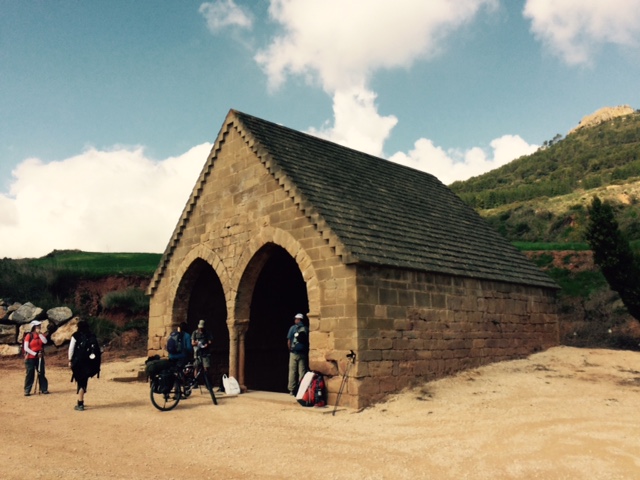
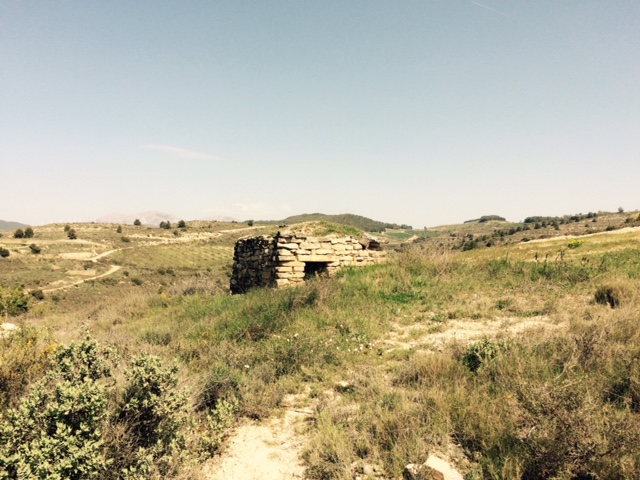
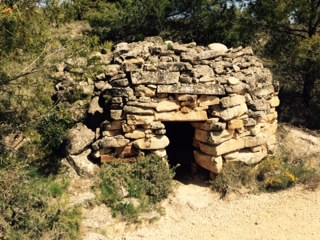
Last night was spent in Viana where I rested before the final push this morning into Logroño.  In the afternoon, I passed several refugios – stone huts built centuries ago and still stanidng.  Built toprovide shelter to earlier peregrinos who might find themselves exposed tothe elements between the pilgrim hostals of the time (often churches and convents encountered on the Way), local townsfolk regularly brought food, water, and kindling to these huts in order that the travelers would have the means to stay strong and healthy,and to continue their pilgrimages.

fullsizerender23

fullsizerender

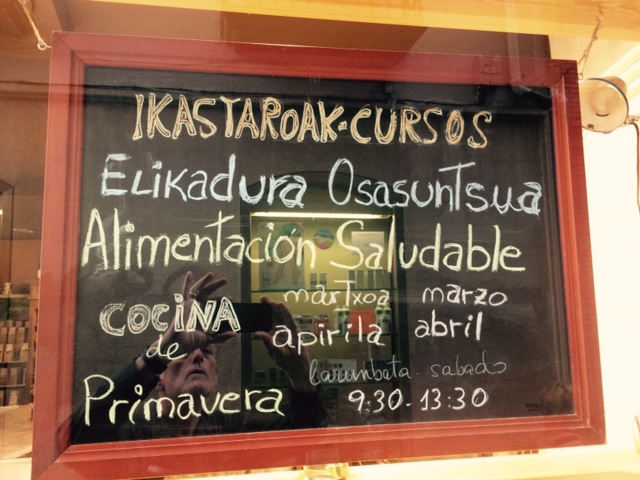
Somewhere along the Way at this point, I left Navarre and crossed into the famous wine growing semi-autonomous region of La Rioja.  Navarre was Basque country with many reminders of the separatist sentiment that is strong with the Basque people.  Here are four such reminders.  The first is a menu written in two languages – first Basque, then Spanish. 

fullsizerender48

Note the difference in the lettering.  Both use the Roman alphabet, but the Basques do it a bit differently.  The second is a street sign. 

fullsizerender50

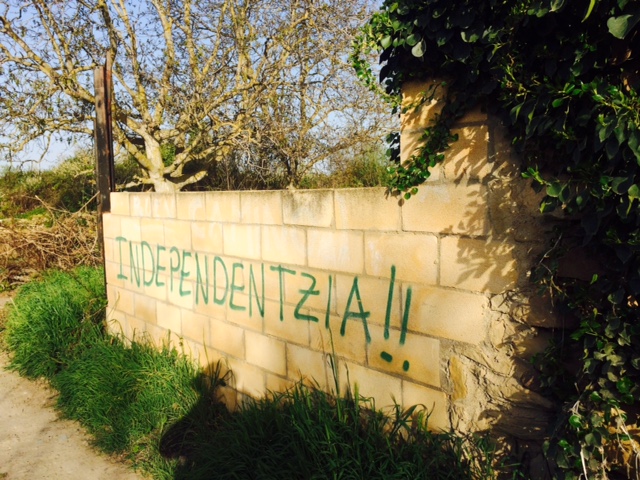
The third and fourth are political slogans found on walls just before entering the final push to Logroño.  Green is the color favored by the Basques.

fullsizerender54

fullsizerender51

I am intrigued by what I sensed traversing Basque country.  I´ll have more to write about that when I return home.

I arrived in Logroño about midday today, in the company of other peregrinos I have met recently. Such is the nature of the Camino.

I found comfortable accommodation at an alberque near the Cathedral and was able to replace several necessary items (sink stopper, cell phone stylus) I had lost en route.  The source, as in Portugal, was a Chinese Bazaar.  Every big city on the Iberian Peninsula seems to have one.

There were many people out walking during the early hours of the day (1000-1200) and early evening (1800-2000).  I was struck by how many were muslim women, covered, in conversation with each other, and guiding their children along their paths.  North Africa is not far away.

img 1397

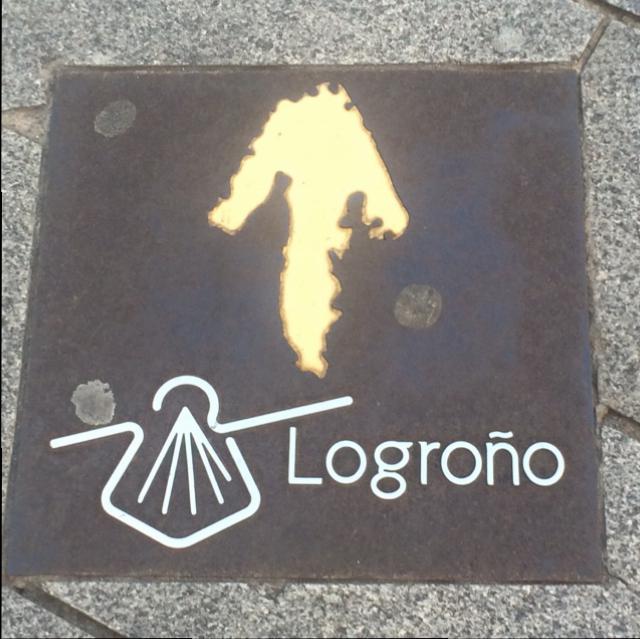
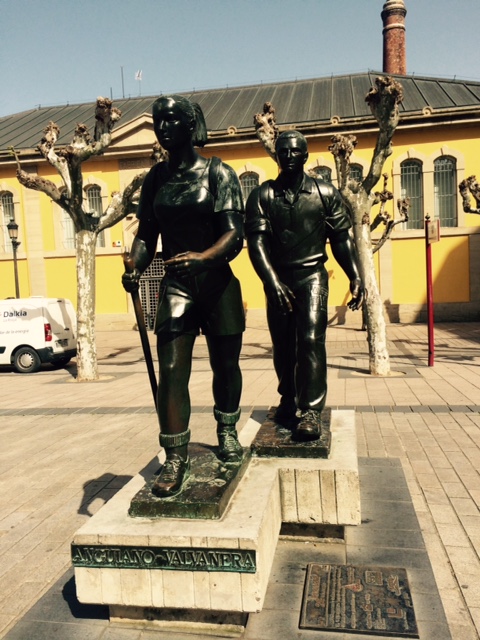
Lograño is a bustling city of about 155,000. It welcomes peregrinos with waymarks and with a statue in a plaza honoring modern day peregrinos.  Note that there are two peregrinos.  Compare this statuary with that in Pedron last year (see FCB #9).  That one features a solo peregrino walking the Way.  The pair in Logroño features two more contemporary peregrinos with determined visages.  The leader is a peregrina with a pigtale.  A sign of the times along the Way!

fullsizerender52fullsizerender53

I´ll post again from Burgos.

And with that, I´m off.

Knute Michael

camino pix

Fog City Boy #12.1


Fog City Boy on the Camino Francés

Pamplona, Spain – April 7, 2015 (republished April 14, 2015)

[Ed. Note:  I have had the very positive experience of working with WordPress staff in resolving issues involving posting of my photographs.  While I am not sure that we understand what went wrong yet, I am able to proceed using a “patch” of sorts.  Enjoy the pictures.  Thank you for your patience!]

The flight from San Francisco to Paris was the best kind – uneventful. I arrived tired but optimistic, made my way to the SNCF railway station at the airport, and took a train to Biarritz (France) where I spent two nights, recovering from transmeridian travel (aka jetlag).  I highly recommend Hotel Le Bon Coin whose staff were friendly and eager to please.

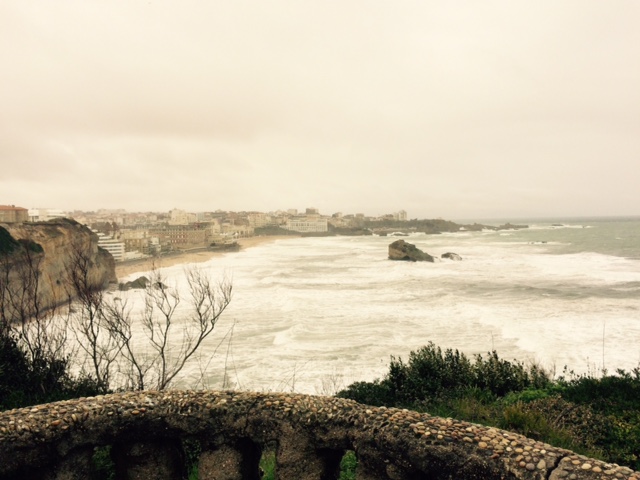
Biarritz is a lovely coastal city with a long maritime tradition. I enjoyed walking along the beaches which were shrouded in overcast skys and boasted turgid waters just offshore.

fullsizerender24

The town has an aquarium and maritime museum that is well worth the time should you visit Biarritz. The aquarium is actually the best one I´ve ever visited!

Adjacent to the aquarium is a very moving memorial to citizens of Biarritz who died in World Wars I and II. Particularly poignant are plaques listing not only the soldiers and sailors who died in uniform, but also the members of the resistance who were killed, those deported to the Nazi death camps, and also common citizens of Biarritz who were killed during the second world war. The statuary adjoining the memorial brought a lump to my throat.

Followers of this blog will recall that last year on the Camino Portugues, I met only nine peregrinos between Lisbon and Porto – about half way to Santiago! But on the Camino Frances, I met over nine peregrinos at the railway station in Bayonne – before any of us even got to the start! Americans, Australians, Japanese, Germans – all the world was there.

St. Jean Pied de Port (France) is a lovely small town of only a few hundred inhabitants – most of whom appear to be there to service the needs of tourists, not all of whom are about to set out on the Camino.

fullsizerender26

I called at the Pilgrim Office, got a stamp on my Credencial (pilgrim passport) and inquired about the weather on top of the mountain. Bad news – there was 16 inches of snow on the ground and it was still snowing. Clearly the preferred route to Roncesvalles was not available. That notwithstanding, I met a 20-something young fellow traveling with a Rhodesian Ridgeback named “Apache” who was determined to brave the “route of Napoleón.” I hope he made it. Or better yet, I hope he took the alternate route as did the rest of us.

Immediately after departing St. Jean, the Way traverses lovely rural highways and byways. After about two hours, the Way crosses into Spain. There is no marker at the boarder. But the language changes abruptly.

fullsizerender27fullsizerender28

I allowed two days for the first stage – not wanting to over commit until I got my “walking legs.” Once in Roncesvalles, I toured the facilities, including a beautiful church, and an alberque (pilgrim hostel) that can house over 100 peregrinos. A hospitalero there told me that they had housed 350 peregrinos the previous night. Apparently many Spaniards take advantage of a four-day Easter holiday weekend and walk from Roncesvalles to Pamplona as an Easter pilgrimage.

fullsizerender31

The next morning, many peregrinos set out for the two day walk to Pamplona. Clearly, Fog City Boy has a ways to go!

fullsizerender32

fullsizerender33

Most of the two days that brought me to Pamplona was through rustic territory rather than along busy highways. Again, quite different from the early stages of the Camino Portugues last year.   Not all of the Way is flat and user-friendly to your legs and feet.  Much of the Way is steeply up hill.  And steeply down.

fullsizerender30

My lodging in the small town of Zubiri was a small pension that was a fifth story walk-up . . . after a long day of ups and downs!  But peregrinos go on undaunted!

In addition to peregrinos going by foot, I encountered cyclists, and others traveling by horse. Apparently there is a service that boards the horses overnight and returns them to the caballeros fresh in the morning.

Along the Way, I encountered a memorial to a young peregrino whose Camino ended earlier than it should have. Passing peregrinos have placed small stones on the cross in recognition of the pilgrimage, and the loss.

fullsizerender36

fullsizerender37

Pamplona is a lovely city with many magnificant builidings and a charming old town to explore. On the day I arrived, a Basque separatist demonstration was in full swing. Literally thousands of Basques had traveled there to make a point and to party. It was a big and joyous party!

fullsizerender41

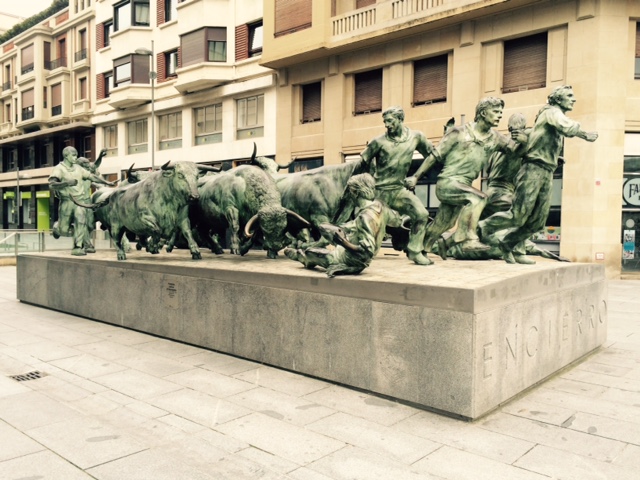
The bulls were not running, but a large monument in the center city attests to Pamplona´s pride in the event, and the danger inherant in it.

fullsizerender42

fullsizerender43

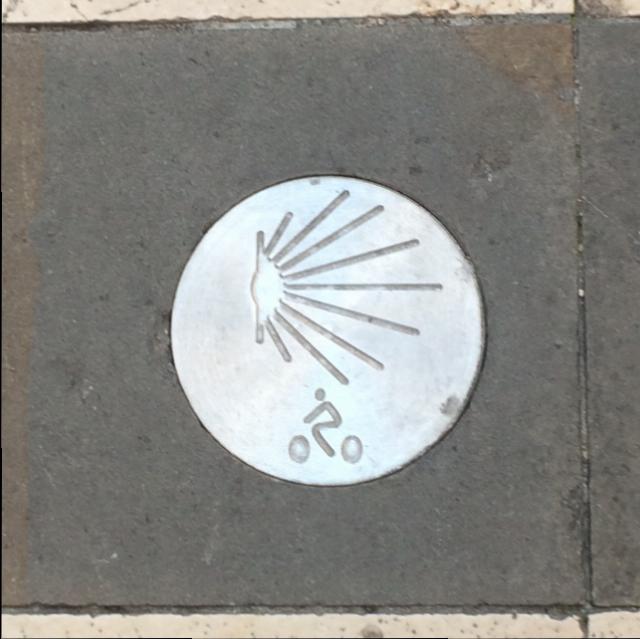
Throughout its history, Pamplona has welcomed pilgrims of all nationalities and faiths. They even welcome cyclists with special waymarks emplaced on their streets. Steven, this one´s for you!

img 1304

Thank you for following my progress! I´ll post again in a few days.  If this is your first visit to the blog and you wish to follow it, click on the button on the lower right corner of your screen.

With that, I´m off.


Knute Michael

camino pix

Fog City Boy #11

Fog City Boy on the Camino Francés.

San Francisco, California – March 27, 2015

“The Camino is calling to me . . . “ quoth daughter Elizabeth some months after she returned to San Francisco, having completed her Camino pilgrimage in April, 2010. I had a sense of what she meant. Now I know for sure. The Camino is calling to me, and has been for a time.

camino trail

For many, the Camino is a religious pilgrimage. My Camino experience last year did not rise to that level, but there were spiritual aspects to it, and I completed the peregrinación with an enhanced clarity of purpose for the future.

And so, tomorrow I will travel from San Francisco and return to the Camino – this time the Camino Francés – the most traveled Way of St. James. It begins for most in the small town of St. Jean Pied de Port in France close by the border with Spain. The first stage is a climb up and over the Pyrenees to the small Spanish village of Roncesvalles. Then the Way turns west toward Santiago de Compostela. 

camino maps

There are many established Camino routes, though actually one may start from anywhere in the world. But all Caminos end in exactly the same place – the plaza in front of the Cathedral of Santiago.  Some peregrinos go on from Santiago to Finisterre or “the end of the earth” as the Romans understood it.  I’ll save that for another Camino.

I’ve been training for the Camino – rowing on the erg (the indoor rowing ergometer), cycling on the Spinner, and walking with my pack. Unlike last year, this year I know what I’m getting into. And I can’t wait!

camino de santiago field fe

(By the way, the snapshot of me above was taken by an obliging peregrino from Brazil on the last day of my Camino last year – shortly before I climbed into SantiagoI’m clean shaven today, but I will again leave the razor at home.  After all, it weighs about 8 ounces, and who would want to carry all that extra weight?)

I’ll be posting to this blog about once a week – my first post will be from Pamplona, about 5 days after I depart St. Jean. I hope you will follow this chronicle, and share your thoughts as I go.  If you wish to follow the blog  – to receive notifications directly to you shortly after I publish – click on the button on the lower right side of the screen.

With best wishes, buen Camino!

And with that, I’m off.


Knute Michael

fullsizerender

Fog City Boy #10


Fog City Boy on the Camino Portugués

San Francisco, California – June 19, 2014

Home again, home again. It is one month since I arrived in Santiago and completed the Camino Portugues.

Ginna and I enjoyed several days in Santiago, took a very long train ride that eventually deposited us in Bilbao (a city on the Camino del Norte, though we looked in vain for way marks), and after two nights, boarded a Brittany Ferry for Portsmouth. We had almost a week in London. Time to visit friends there, and to bridge from Camino to the joys and challenges of being home again.

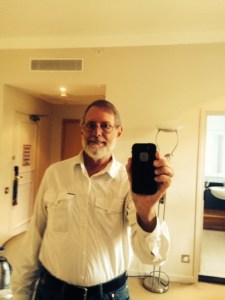
That said, I’m glad to be home! I lost about 8 pounds over the 46 days of the Camino, but arrived at my destination in good health. I am fuzzier than I was when I departed San Francisco three months ago – referring to my physiognomy, hopefully not my intellect. My electric shaver and charging cord weigh a bit more than a half pound. I didn’t want to carry the extra weight, so I left it at home!

Selfie #1 was taken in Vila Franca de Xira five days after departing San Francisco.

Selfie #2 was taken in London five days after arriving in Santiago.
This post will serve several purposes.

I use it to address a number of issues, observations, and experiences that I did not include in earlier posts, and it will serve as what the Army would term an “After Action Report.” I have included a number of assessments about my Camino, my preparation for it, and the gear I took with me in hopes that it will be of use to a future peregrino who might read this blog. The blog is a public blog, available to anyone. It will stay on the web for a while (and likely be added to as future adventures unfold).

I conclude this posting with a video and audio of the swinging of the botafumeiro at the Cathedral in Santiago.

First, I wish to acknowledge the many comments I received to the several postings. I did read them all but was unable to acknowledge them while en route. They were encouraging and I appreciate them!

Next, I wish to thank those who helped prepare me for the Camino: in particular, daughter Elizabeth, friend Lin, friend Joan. And Jim.

And now to the substance of the post!

  • A way mark that didn’t post.

 The picture I took in Viriville, France several years ago did not post successfully when I published Fog City Boy (FCB) #2. I had to return home in order to upload it properly. Here it is.
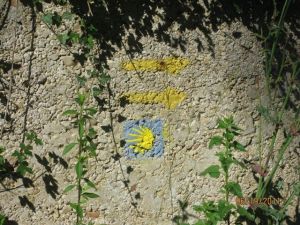
Old salts (San Francisco Bar Pilots) may seek it out the next time they train at Port Revel.

  • Corrections and amplifications.

In FCB #1, I wrote that the Camino de Santiago is thought to be the most important pilgrimage in the Roman Catholic communion. I stand corrected. The pilgrimages to Jerusalem and to Rome are of a higher order. The pilgrimage to Fatima, Portugal also ranks high in the hierarchy of pilgrimages.

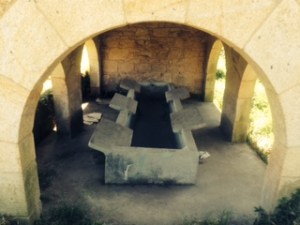
In FCB #7, I reported that the outdoor community laundries all had a similar design. In fact that turned out not to be the case as I made my way north. I found the laundries in Spain, as well as in Portugal. One constructed quite recently had individual “stations” for the townsfolk using the facility.
In FCB #3, I reported that a pickpocket in Lisbon had relieved me of my wallet. When I returned to San Francisco and sorted through the boxes of mail that had arrived, I found a small white package from France addressed to me. Lo and behold, it was my wallet – with driver’s license, military i.d. card, credit and debit cards (long since canceled and replaced), and US dollars placed in the “side pockets” of the wallet. The euros, of course, were gone. The pickpocket wanted only the cash, and none of the other items that would have been incriminating in his (or her) possession. A vacationing Frenchman found it on the floor of the tram where the larceny occurred, and very kindly sent it to me with a note explaining how it came to be in his possession. How very thoughtful.

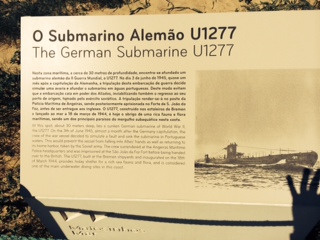
In FCB #8, I included a reference to a World War II German submarine that was scuttled by its crew after the secession of hostilities. Here is the plaque again, and English description:
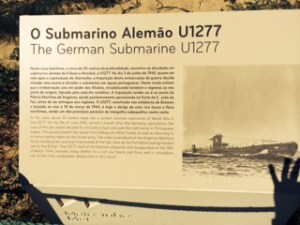
The German Submarine U1277

At this spot, about 30 meters deep, lies a sunken German submarine of World War II, the U1277. On the 3th [sic] of June 1945, almost a month after the Germany capitulation, the crew of the war vessel decided to simulate a fault and sank the submarine in Portuguese waters. This would prevent the vessel from falling into Allies’ hands as well as returning to its home harbor, taken by the Soviet army. The crew surrendered at the Angeiras Maritime Police headquarters and was imprisoned at the Sao Joao da Foz Fort before being handed over to the British. The U1277, built at the Bremen shipyards and inaugurated on the 18th of March 1944, provides today shelter for a rich sea fauna and flora, and is considered one of the main underwater diving sites in this coast.

  • Fashionistas.

I couldn’t help but notice the young women in Portugal, the majority of whom dressed a la mode, which is to say that their pants appeared to be spray painted on in solid colors (usually black or denim blue) or displaying outrageous floral or geometric patterns. And many wore 5 inch heels, supported by 1 1/2 inch platform soles. These presentation choices were ubiquitous both in large cities and small towns. The platform shoes increased in frequency as I headed north, likely because of the passage of time (time to “get with it”) rather than changed geography. Spain was no different!

When I got to London – all the world was there in Picadilly and in Mayfair – attire was the same, only more so: a fashionista every three meters.

The older women in Portugal and some of the younger married women as well, often wore black skirts and tops, or a black house dress. It was not unlike the images from post-World War II movies set in southern Europe. This attire was particularly the case in smaller towns along the way, but even in the cities, most older women dressed quite conservatively – in deep blue if not in black.

The professional men and women I encountered along the Way (including a substantial number of women who were advogados) would have been quite at home dressing for a court appearance in the States. All wore conservative dark colored suits. And all business people in Portugal seem to carry an obligatory, if small, briefcase to and from the office. Whether the briefcases contain homework, or lunch, or simply are a convenient way to cart one’s ipad, I don’t know.

The young guys along the way dressed the same as their counterparts in the States: Lots of athletic jerseys and t-shirts. The older, apparently retired gentlemen wore tired looking trousers and sport jackets, often with a cap or other headgear.

Not surprisingly, the young guys in London were just as fashion conscious as the young ladies.

  •  Dogs and Cats

I believe that I was barked at by every dog in Portugal north of Lisbon (except two). With few exceptions, all the farm houses in the rural areas, and many of the houses in the residential sections of the cities and towns through which I passed, had guard dogs. Generally they were tethered to a post or a stake in the ground. But that did not stop them from barking and growling menacingly and leaping in my direction only to be constrained by the tether.

The first dog to espy this peregrino would bark furiously and, as I passed, the duties were transferred to the dog next door, and then to the dog further on. This process often went on for a dozen or more houses or farms.

Occasionally the dogs were not tethered but were allowed to roam freely behind a high or relatively high wall surrounding a pleasant house. That circumstance often was anxiety-provoking because any of many large, loud, and angry dogs could have leapt over the wall and taken a bite out of my neck had they wanted to.

One small terrier that was not tethered and was free to roam the street in fact did take a nip at my heel – likely incensed that I had simply ignored him while passing by his house. No harm done but, though ineffectually attacked, I turned and faced my attacker, leveling my walking sticks in his direction. That kept him at bay but the ensuing cacophony emanating from the outraged mutt eventually brought forth his owner, who silenced the dog, and apologized to me for his behavior. I went on my way.

The only two dogs that didn’t bark at me were both Labrador retrievers! They ignored the uproar in their neighborhood as I passed through it, and in typical lab fashion, smiled at me as I walked by.

As to cats, it may have been my imagination, but it seemed that there were an unusual number of Siamese cats in Portugal – running free in the vicinity of their owners’ homes. Most Siamese cats of my acquaintance in the US have been “indoor” cats. Not so in Portugal.

  • Nutrition, hydration, and electrolytes.

Some time ago I embraced the notion that food should be viewed as fuel for the body and that fuel intake and processing need to be harmonized with the demands placed on the body. In the context of the Camino, that meant what, when, and how much I ate needed to be reconciled with the endurance efforts I would ask my body to do that day.

Don’t come to me with nothing in the tank.

On mornings when I had access to a hot meal at breakfast (typically scrambled eggs and bacon, cheese, ham, and sausages, too) or when breakfast went beyond white bread, butter and jam, and coffee or tea – the basic European “continental breakfast” – my walking pace and stamina were noticeably better than on those mornings when bread, butter, and jam were all that was available. On those occasions (four of them), I sought out a cafe as early as possible and loaded a pastry of some sort. That and a cafe con leche would get me up and moving – but I knew that the sucrose/lactose/caffeine boost would burn off in two hours or less, so I kept looking for something solid to eat before it got too late in the morning. I carried two tins of sardines with me to serve as emergency rations. I’m glad I had them along, though I never had to resort to them.

I had some good meals in Portugal, but most of the simple restaurants along the way served a large slice of meat (roasted previously and reheated upon order) or fish, with a scoop of white rice, a small salad of chopped lettuce, shredded carrots, and a tomato slice – and a half plate of soggy french fries. Chicken was more frequently available as I walked north. Fresh fish, squid, and octopus were available in the larger coastal towns, and in Santiago. I saw goat on the menu from time to time. I had cabrito a couple of times.

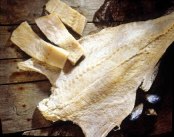
Bacalhau (dried and salted cod fish) is ubiquitous in Portugal and often available in Spain. There are as many recipes for reconstituting the salt cod as there are cooks in that part of the world. I had it a couple of times and lived to tell the tale. But it certainly wasn’t my favorite repast.
bacalhau+%25281%2529.jpg

What was lacking in virtually all meals in Portugal was a fresh vegetable. I know that they grow veggies in Portugal and Spain because I have seen them in the farmers’ markets, but the restaurants patronized by the common folk apparently haven’t gotten the word yet. I completed the Camino suffering from serious veggie deficit. On two occasions when I told the waiter “no batata – legume si” I was able to avoid another round of soggy french fries, but what came in their stead was a mound of soggy broccoli florets.

Most of the shops and public offices are closed from noon until 2:00 p.m. or so. The siesta lives! Lunch is the major meal of the day in Portugal and lunch time is usually about 1:00 pm. I discovered that it is possible to order a “1/2 dose” for many items on a typical (but limited) menu. But even the reduced serving size was easily enough lunch for two people – even peregrinos who had walked all morning. Most meals at lunch and dinner begin with a plate of olives, white bread, and a bowl of thick orange soup of indeterminate composition. If you order vegetable soup, they put some cabbage or white beans or carrots into the orange base. If you order fish soup, they put some fish of indeterminate species into the soup of indeterminate composition. These soups actually taste pretty good, notwithstanding uncertainties about composition. I found that simply ordering a soup and some bread along with the olives did nicely for me at lunch.

images?q=tbn:ANd9GcTIXxTXcaW4lt9zqPSP5x8uzb_MrVJMpaRbXbGa2BpYcHMkdGbR6A

Proper hydration is critical to success in any athletic endeavor, so much the more so when it is an endurance trial. There were a few days when the Way was long and the sun was hot and I became mildly dehydrated. No harm came of it, but after my woosie arrival at my destination on that first long hot day, I packed a standby bottle of still water inside my pack just in case. In addition to carrying and refilling my water bottle, I typically ordered a bottle of water (still or con gas) at the cafes where I stopped to rest and use the available facilities. There are fontes in every town and along the roads in both Portugal and Spain. However, most bear signage warning that the water is not potable, or at least, not controlled. I avoided the water from those sources, and had no gastric issues on the Camino.
Electrolyte management also is important. Eventually, I found myself getting a bit light headed early in the afternoons. I didn’t have the presence of mind to go to one of the ubiquitous Farmacias and ask for an appropriate supplement, but I did combat the problem by salting my food moderately heavily, which normally I wouldn’t do. I survived the challenge, but would recommend that peregrinos take with them a supply of supplements designed to manage electrolyte imbalances.

  • Injuries, aches, and pains.

I was quite fortunate not to suffer any injuries and only had a single, very small blister which I drained, cleansed, and bandaged. It healed in two days and there was no recurrence. My legs got sunburned on the first day I walked without the lower leg portions of my convertible hiking pants.  And, I did experience shin splints. Typically they came on at night but abated immediately when I walked a few steps. I was quite faithful about doing my AI (active isolated) stretches each morning before I set out. That discipline prepared my whole body (not just my legs – I was carrying a pack, after all) for the miles ahead of me. Also, before setting out each morning, I applied BenGay lotion to my lower legs, rubbing it in thoroughly, as suggested by friend Joan. That was most helpful in preparing my legs for the challenge of the day. I ran out of BenGay but found a similar camphor-menthol preparation at a Farmacia along the Way.

As an experienced peregrino from North Carolina explained to me, most hikers think that having good shoes is the way to avoid blisters. But actually it is more than just shoes. He pointed out that the shoe, the sock, and the foot together constitute a “system.” And all parts of the system have to work together properly in support of the hiker. I had great hiking shoe from a manufacturer named Asolo, socks from Tilley that were woven in such a way as to provide support to the instep and lower leg above the ankles, and two feet that have been with me for a long time. All three pair worked well together with the result that my feet never hurt and blisters were never a concern. My feet were snug in the hiking shoes. There was no rubbing – the source of most blisters. I had a second pair of shoes – feather weight – that I carried in my pack and wore around town after getting off the trail. They are the barefoot line from Merrell. That allowed my hiking shoes – damp from perspiration – to dry out daily.

The other key to avoiding injury was my decision to carry two walking poles. I got carbon poles from REI that are strong and lightweight. Those poles saved me from falling any number of times on rough terrain and on steep grades. Most injuries on the Way occur when descending a grade. I would urge all peregrinos to take two poles on their Camino – not just one. You can be sure that if you have only one pole, it will be in your right hand when you loose your balance to the left – and vice versa!

  • What to take and what not to take.

The many Camino guidebooks provide lists of things a peregrino should take. Inevitably, a first time peregrino will bring more “stuff” than he or she will actually need on the Way. The solution is to mail the unneeded “stuff” to yourself at the post office in Santiago and collect it after you arrive. The Spanish post offices can help with this. One way to minimize excess “stuff” is to be sure not to have more than one item of a particular sort. I started out with two flashlights (albeit of different designs). I sent one on to Santiago. I had a first aid kit with lots of contents when I started. I sent a number of duplicate items on to Santiago. The Farmacias along the Way can provide whatever might be needed from time to time. I had a set of long-johns when I started, but it wasn’t at all cold when I arrived. I sent those on to Santiago. All in, all done, it reduced the weight of my pack from 17 pounds to 15. The change was noticeable!

One thing that proved invaluable, and that was suggested by my guidebook, was a sink stopper. I did laundry almost every afternoon when I got off the trail. Typically in an alberque/pension/hotel bathroom sink. Not all bathroom sinks had stoppers, but I was prepared!

I carried a small notebook and a ballpoint pen in my shirt pocket. It was hugely helpful to have it close at hand.

My smartphone had two apps that were extremely helpful.  The first was a mapping function with GPS capability.  It got me un-lost a number of times.  The other was a translator app.  It has capabilities that go well beyond English, Spanish, and Portuguese.  When I shopped in the Chinese bazaars along the Way, I explained what I needed by translating from English into Chinese characters on my phone!

A thoroughly researched and easy to read guidebook is a must. I had a guidebook, of course. John Brierley’s “A Pilgrim’s Guide to the Camino Portugues” – carried by virtually all peregrinos whose first language is English. The edition I purchased was the most recent at that time. However, unbeknownst to me, a later edition was published before I set out on my Camino. Especially because of the rapidly developing infrastructure on the Camino Portugues, the changes to the guidebook were many and important. Had I had the 2014 edition, I would have avoided a number of wrong turns and been apprised of a number of alberque options that eluded me. I looked for a copy of the 2014 edition several times along the Way, but didn’t find one until I had completed myperegrenacion! So, I’ll just have to make do with the memories that accompany the one I had with me.

Choose your backpack carefully and learn how to pack it and cinch it before you go. It sounds obvious, but in my case, learning how to arrange the contents of the pack, and how to adjust the many straps so as to adjust the weight and shape of my pack to my back, shoulders, and hips took longer than I care to admit. I would recommend peregrinos do a “dress rehearsal.” Pack your bag so that it is comfortable and the weight distributed evenly. Then go to the shop where you bought it and have an expert adjust the straps for you so that it “sits right” on you. I did eventually get it right, but there were some painful miles while I was trying to figure it out. I had an Osprey back pack. I was extremely happy with it. It had a 35 liter capacity – a beneficial constraint that forced me to adhere to good packing discipline. Finally, take to heart the advice I was given – limit the weight of your pack to 10 percent of your body weight. No more! Travel light! Schooner rig! 

  • Whatever happened to . . .

On the Way, the peregrino meets others headed to the same destination. While each pilgrimage is its own story, some of the stories are particularly compelling. Unfortunately, because peregrinos progress at their own paces, it is not always possible to know the outcome of some especially poignant stories. Here are three:

 Whatever happened to “Santiago?”

I spent one night at a rural casa called Casas Do Rio – houses of the river.
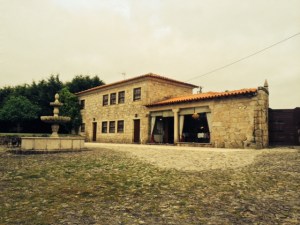
A lovely and serene estate with historic accommodations for peregrinos and others located in Cossourado, Portugal. (I highly recommend this rural casa.) There were three women peregrinos from Phoenix who over-nighted there, and five young German peregrinos – one guy and four women. And a very nice stray dog that had followed the Germans for much of the day. One of the German women decided to adopt the pooch. They were very devoted to each other. She spent considerable time on her cell phone determining the requirements to take him home to Germany with her after the Camino. Next morning, the women from Phoenix and I left before the Germans did. We walked together for several hours. One of the women announced that they had decided that the dog should be named “Santiago.” None of us knew what “Santiago’s” new mistress would actually call him. And we had concerns for him, too. He had a bit of a limp and appeared to have been separated from his original family. Walking all the way to “Santiago” might have been as difficult for him as it was for us. And it is not clear where he would overnight along the Way. Would the alberques along the Way take them both in? We did not see the cohort of Germans again, and never learned what happened to “Santiago.”

 Whatever happened to Gisela?

(Not her real name.) Gisela was a lovely, young, very intelligent, very blond, very sunburned German peregrino who, with a group of other Germans, were walking the Way for several days in tandem with my own progress. As a group we had gathered together at cafes along the Way, and dined together and they had been very tolerant of my very awkward, mostly forgotten, gesprochenen Deutsch. We had dinner one night at a pleasant restaurant in Ponte De Lima. The conversation was casual all around. We returned to our respective lodging, with Gisela and another woman returning to the alberque via the bridge crossing the Rio Lima.


I learned the next morning that half way across, Gisela produced a notebook in which she had written of all the troubles she had had with her family. She tore the pages out of the book, tore them in pieces, and threw them all into the river. And watched them float away. “Now I am free,” she announced. “I am going to get to Santiago as quickly as I can, and go home. I’ll make 30 kilometers a day.” Apparently she was up and out of the alberque and on her way at 6:30 the next morning. She was a very nice girl, and I hope that the Camino had given her the freedom she had sought and believed she had found. We did not see her again.

Whatever happened to Richard from England?

(Not his real name.) Now in Spain, one morning I met a peregrino from Ireland named Richard. (Not his real name, either!) He was a bit older than I and on his 10th Camino. He said he walks two Caminos each year. We walked together for a time, and then I went on ahead. I passed through Redondela and spent the night at a pension four or five kilometers further along the Way. The vista from the pension was wonderful. I thought that I had found California poppies when I looked out the window. Close, but clearly a different species.
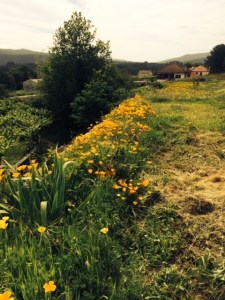
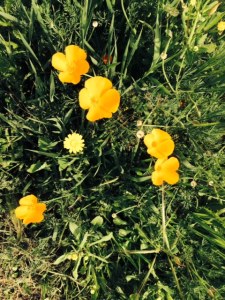
Both Richard from Ireland and another peregrino, Richard from England, spent the night at an alberque in Redondela. That alberque is reputed to be quite comfortable, albeit located close to a nightclub that is noisy into the wee hours of the morning. Though a long way from that alberque, I got a late start the next morning, forgot my hat and had to go back to the pension to retrieve it. In due course, I saw Richard from Ireland and others some distance ahead of me. I paused at a fonte for a snack and noted a passing peregrino – a burly fellow with a wooden staff for a walking stick, walking in sandals without socks (guaranteed to bring you many blisters), and sporting a swetty red shirt. I wished him buen Camino but he didn’t acknowledge me.

Farther down the road, I came upon Richard from Ireland sitting in front of a cafe drinking a beer. I tossed down my pack and decided it was time for a break and a bite. “Did you see a pilgrim in a red shirt today?” asked Richard from Ireland. I said that I did but that he had gone on ahead of me. Richard said that the pilgrim in the red shirt was inside the cafe, also was named Richard, and would be out in time. He then went on to say that last night, Richard from England had been in the other of the two bunk rooms in the alberque (each with about 10 bunk beds), and that when they met at the cafe a bit ago, Richard from England said to him, “Did you hear the commotion last night?” Richard from Ireland had not heard it. “Well, I urinated on a woman in the alberque, and she complained to the hospitalero. He called the Spanish police, who came to the alberque and threw me and my stuff out into the street. I spent half the night on the street.”

About that time, Richard from England appeared. We introduced ourselves and I told him I was from San Francisco. “Ya been up to the jail yet?” I wasn’t sure what he was getting at, so he clarified, “Alcatraz.” Ahhhh. That was easier to deal with. Yes, I have visited Alcatraz. I considered asking him which jails he had been “up to.” But I decided against it.

I got up to go get a sandwich. “Buy me a beer,” he directed. “I’ll pay you back.” Well, this might have been my first Camino, but it wasn’t my first time around the block. I got him his beer, assumed I would never be repaid, and was not disappointed. Richard from England downed his beer and went back into the cafe. I turned to Richard from Ireland and said, “He is a strange fellow.” Richard responded, “you forgot one word.” . . . “What’s that?” . . . “Very!” I ate half of my sandwich, finished a bottle of water, and headed on. I didn’t see either peregrino again. I wonder what kind of trouble Richard from England got into later on his Camino.

  • Way marks.

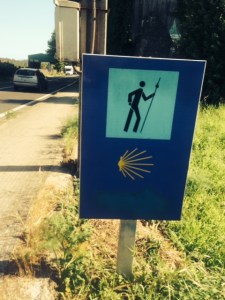
I know that the blog has included images of a number of way marks I encountered. But here are several more that I found particularly noteworthy.
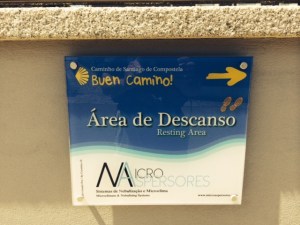
And the prizewinner is . . .
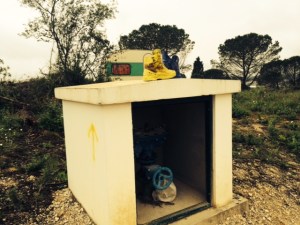


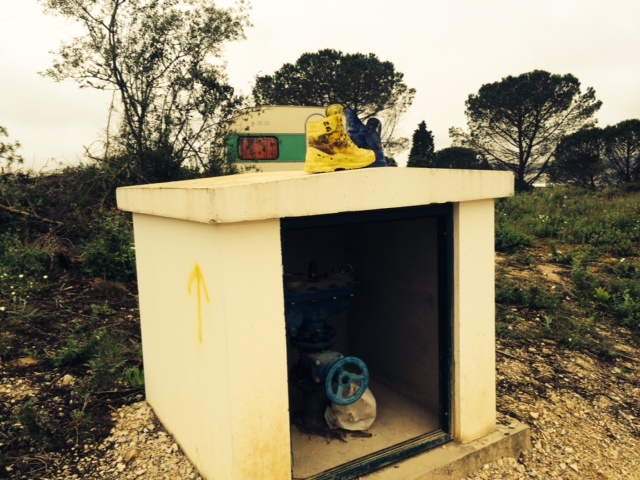
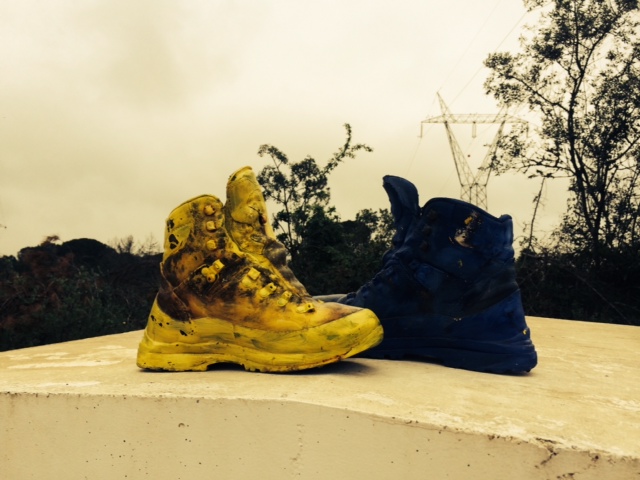
This way mark was atop a boxlike structure in a clearing in a wooded area shortly before descending into one urban town or another. The Way at this point is shared by the Camino de Santiago and the pilgrimage to Fatima. The pilgrimages head in opposite directions through most of Portugal, though they share the same trails. The Fatima way marks are painted in blue; the Camino’s in yellow. This way mark is composed of two hiking shoes pointed in opposite directions – one in blue, pointed toward Fatima, and one in yellow, pointed toward Santiago.

  •  Kindnesses.

As I consider the Camino – my Camino – I am reminded of many acts of kindness of which I was the beneficiary. The locals who showed me the right way, when I was headed the wrong way. The fellow who offered me a lift when I was exhausted and in difficulty. The British ex-pats living in Portugal whom I met in a rural cafe who helped me order a toasted ham and cheese sandwich for lunch, and then bought me lunch! The hospitalero who was prepared to collect me some distance away from her pension and find me a place to stay, if the next pension on my way was closed or full. Another hospitalero who, rather than rely on my comprehension of his directions, drove me to a bus stop to be sure I knew where to catch a bus the next morning. The restaurateur who gave me a tour of the town after I finished dinner one night. The peregrinos I met along the way, especially Monika and Siegwart from Germany, who – fearing that the alberque they had found would not have space for me should I arrive later that evening – prepared a window cushion mattress for me in their room so I would have a place to stay. In fact, I was safe and slept well at the Casas do Rio that night. And the French vacationer who mailed my wallet back to me.

And so, as I contemplate my Camino now, a month after my arrival in Santiago, I again find myself thinking of gratitude. Gratitude for the fitness and strength to begin and complete the peregrinacion. Gratitude for the kindnesses shown me so frequently on the Way. Gratitude for the Camino itself.

  • The Pilgrims’ Mass and the swinging of the botafumeiro.

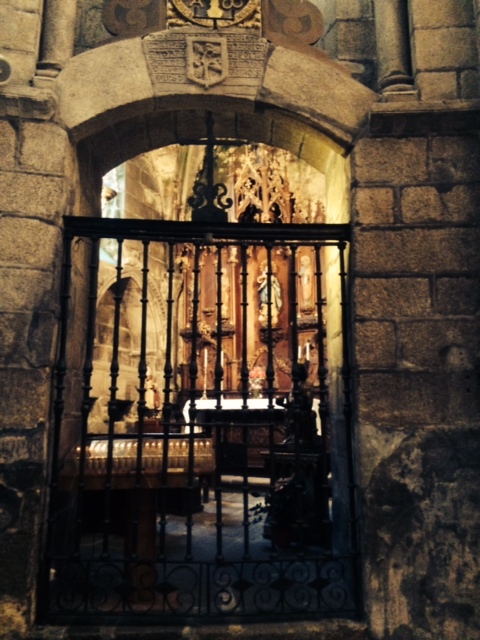
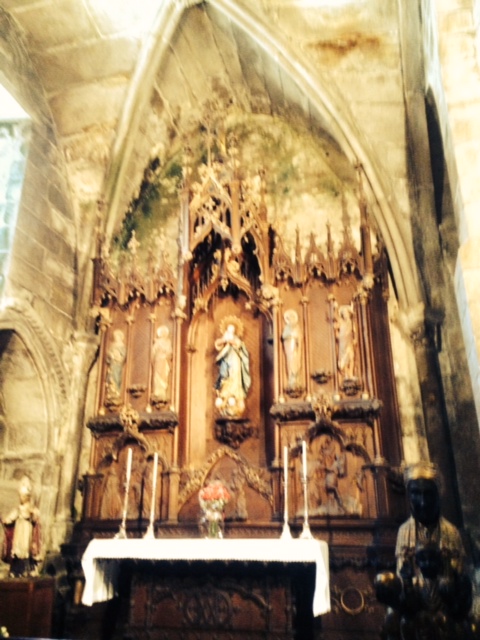
The Cathedral de Santiago is great and magnificant. It harbors many examples of extraordinary religious art commissioned over hundreds of years. Here are images from one of the chapels around the walls of the church.
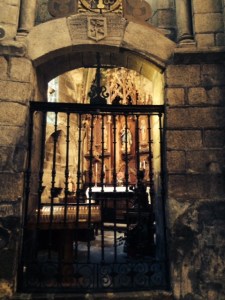
Ginna and I attended the Pilgrims’ Mass shortly after my arrival in Santiago. As I reported in FCB #9, I was not able to upload my video and audio recording of the swinging of the botafumeiro incensor (which concludes the mass) at the time I completed that posting. I have since been able (with some help from Ginna) to achieve that feat.

The swinging of the botafumeiro marks the end of the pilgrims’ mass at the Cathedral, and in so many ways brings closure to the many peregrinaciones that conclude in Santiago. The swinging of the botafumeiro seems to be an especially appropriate conclusion to this chronicle of the Fog City Boy on the Camino Portugues. I hope you will watch it and enjoy. The video is almost 6 minutes long and includes words from the celebrant setting the context before the actual the introduction of the botafumeiro. The audio is important, too. Peace be with you.


Thank you for following this chronicle.

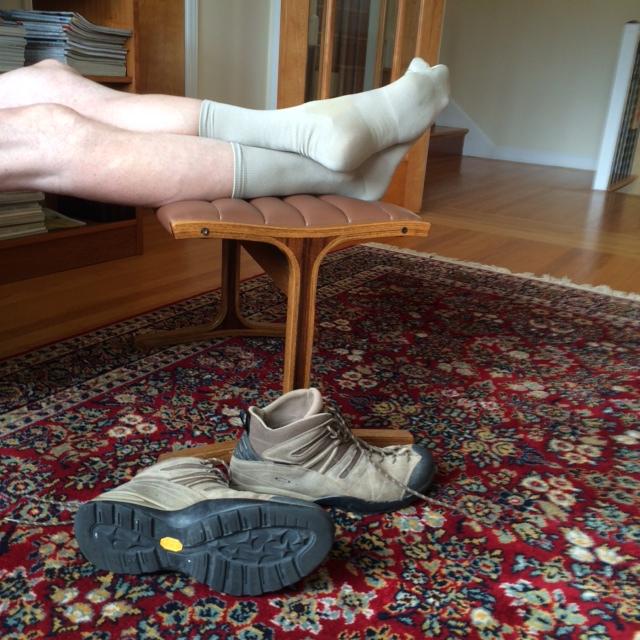
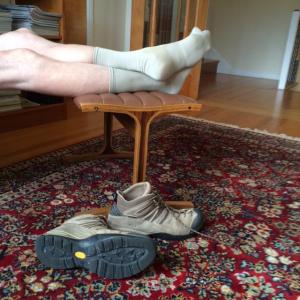
And with that, the boots are off. My feet are up.

And I’m not off to anywhere just now. . . but stay tuned!

Buen Camino!


Knute Michael
Fog City Boy #9

Fog City Boy on the Camino Portugués

Santiago de Compostela, Spain – May 19, 2014


This blog posting is written in two segments – the first is from Padron, "on the Way," and the second from Santiago upon conclusion of my peregrenacion.

* * * * *


Padron, Spain – May 15, 2014

The Way from Tui has been one filled with a certain excitement as I approach the last two days of the pilgrimage. There are many more peregrinos on the Way now. The majority are Germans, as before. But also Spaniards, Canadians, Australians, and yes, a handful of Americans (clearly in the minority). I had a nice conversation with a woman from Redlands, California wherein we lamented the limited representation by our countrmen. "Americans don’t walk anywhere," she observed. "That’s why there are so few of us on the Camino." True enough, but distance from home also is a factor. That said, distance never stopped an Aussie from going anywhere! And they are prominent in the mix of peregrinos.


There is an expectation that a peregrino will collect two stamps in his or her Credencial each day during the walk through Galicia. I have secured stamps not only from those pensions and hotels where I have spent the night, but also I have my assortment of stamps from restaurants, museums, chapels en route and one from the Galician public safety folks who were parked along the Way yesterday collecting statistics about who was on the Way and where we were from. I had a conversation en route with a delightful girl who works for a Futbol Club in Malaga. She and her Espana-born parents visiting from Venezuela were making their first Camino walk. Her boyfriend is from Oklahoma and wants to join a police force in Silicon Valley. It’s a small world.


The cohort of peregrinos headed to Santiago of which I am a part has coalesced into a friendly gaggle of walkers, if not a Camino family per se. We find ourselves at breakfast in the mornings, having checked into the same habitacion but not knowing until the next morning. Stops at cafes en route are also sites for reunions.


After crossing into Spain from Portugal, my first night was spent in Tui. I explored the town (it was a Friday night) and in the early evening many of the denizens and their families turned out to enjoy the pleasant weather. One plaza boasted four sidewalk cafes and a bandstand. A young ensemble was singing popular Spanish ballads but eventually made a break with tradition and covered a dozen American rock and roll classics.

The next day I had a good breakfast and met a trio just starting their Camino. Mom was from the Central Valley in California, and her son and his girlfriend claimed Oakland, California as their present domicile. We left at different times but caught up with each other at a cafe along the Way. Haven’t seen them since, but hope to meet up in Santiago. I have had a pleasant time walking with and talking with a couple from Alberta, Canada. I saw them at breakfast this morning, but since today is a recovery day for me, and they are going on – again – I hope to meet up in Santiago.


The Way from Tui to Porrino traverses an uninteresting industrial park, but also meanders through woodlands for much of the way. One somber stretch passes the Cruceiro San Telmo and then crosses the Puente das Febres.


The Cruceiro and adjacent monument and bridge memorialize the sad death of San Telmo (Saint Elmo) in 1251 who was returning from a pilgrimage to Santiago, but succombed to a fever just a few kilometers before reaching his home, and origin of his pilgrimage, in Tui. Nearby, a circle of dressed stones in the shaded wood offers passing peregrinos the opportunity for rest and contemplation. Many peregrinos leave a small stone at the monument as recognition and to honor the pilgrimage of San Telmo.


As the Way takes the peregrino further north, it follows the ancient Roman military road, Via Romana XIX, which was part of the original Camino Portugues. Those who determine the way marked routes of the modern day Caminos try to remain faithful to the original paths laid out hundreds of years ago. Modern highway construction and urban development does not always make this possible, however. Fortunately, the Via Romana survives well in these parts. The cylindrical way mark is a Roman original.


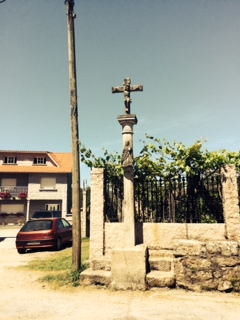
The Way from Lisbon did not suffer from a lack of cruceiros. But the reminder of the faith, and the implicit blessing of the traveler, are increasingly frequent as the Way approaches Santiago.


The yellow arrow that has led the way for three hundred miles apparently is being supplemented in Spain by an arrow best described as florescent chartreuse. Certainly they are easy to spot – not a bad thing at all – but time will tell how they weather and age.


Departing the town of Arcade and crossing the Rio Verdugo takes the peregrino across the Ponte Sampaio, dating from 1795 and still very much in use by local pedestrians and vehicles. It is only one lane wide.


The days of late have been a bit longer (in distance and in hours of sunshine) and the temperature a bit warmer than most days in Portugal. Shortly after arriving in Pontevedra, I took advantage of the hot springs there, allowing my tired feet to experience the curative waters at a local fonte.


And yesterday brought me to Padron where Santiago began his ministry in Spain. The Convento do Carme (from the 18th century) dominates the horizon and provides a backdrop to the Fonte do Carme (from the 13th century).


At least two other features of the town deserve attention: The first is a statue in the town square of a peregrino earnestly pressing forward on his Camino. (Note the rock pathway.)


The second is the gastronomic wonder – pementos padron. (I believe the spelling is Galician, not Spanish.) Although native to South America, these mild peppers flourish in the soil and weather in the region of Padron. Lightly sauteed in olive oil and dashed with seasalt, they are a wonderful addition to a meal here, or anywhere else. (They are now available fresh in San Francisco.) When in Rome, do as the Romans do. When in Padron . . . .


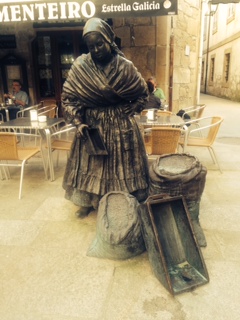
Public art is common along the Way. The statue of a peasant woman selling her produce graced the front of the Restaurante O’Pementeiro where I enjoyed the house specialty (above). Note the detail on the back as well as the front of the statue. The neighborhood kids loved to climb all over this plaza resident!

I have composed this post during my day of recovery before comencing the last two days of my Camino first thing tomorrow morning. The day today has provided the opportunity for reflection on the six weeks that have elapsed since I began my Camino in Lisbon. Where I have been, and where I am going. Peregrinos and others I have met along the Way. Some with stories told, and others with stories hinted at but not fully told. It has been a good day, with further reflection to come as I complete the Camino Portugues.

* * * * *

Santiago, Galicia – May 18, 2014

I had intended to be up early and out the door of my lodging in Padron not later than 7 am. However, about 2 am I determined to turn off the alarm clock and simply wake up naturally. Which I did about 8:15. The net result was a departure on my relatively short next-to-the-last day at 9:15 – not an auspicious beginning to the last two days of the Camino! But, hey! I planned the last two days on the Way to be restful ones.

The Way wound its way through lovely vineyards and haphazard byways in old towns. It was a pleasant reminder of my earlier travels along the Way.

I had intended to stay the evening at a rural casa – a small country hotel about half way between Padron and Santiago, and continue the final push to Santiago early the next morning. But, as luck would have it, I didn’t recognize the Casa when I passed it and only discovered my mistake when I reached a small town (that wasn’t supposed to be there) four kilometers later. I didn’t feel like going back, so I kept going, intending to check in to a hostel on the outskirts of Santiago still some distance from the historic town center.

En route, I passed a way mark showing slightly greater than 10 kilometers to Santiago. An obliging peregrino from Argentina took a picture of me showing off my trusty water bottle that had kept me hydrated on this endurance event, and others before it.

Shortly after that break, I came upon another way mark, this time showing 9.8 kilometers to Santiago. Another peregrino passing this way had left a small bouquet in celebration and anticipation.

photo5
photo5

I walked on and headed slightly off the Way toward the hostel shown in my guidebook. When I got there, I noted the "Vende"sign in the window, and the very locked gate to what had been the hotel restaurant/cafe. As with other endeavors, one learns to expect the unexpected.

There was but one choice: Press on, peregrino, press on.

This last day would be an 16 mile day, considerably longer than my usual 8-13 mile days, and all this with a late start in the morning. The sun was high and the temperature rising.

I called Ginna, who had been in Santiago for a day, and alerted her to my unexpected progress. At this point, the Way was mostly through developed suburbs south of Santiago. But there were wooded areas and parks as well.

The last few kilometers descended into a ravine, climbed up and out, across a bridge over the railway mainline, and then up a steep section of urban asphalt past a major hospital complex, and eventually, to the historic section of Santiago.

I stopped at the traditional city gate used by peregrinos completing the Camino Portugues, the Porto Faxeira. Ginna was on her way to meet me there. I was hot and tired. My legs hurt. My shoulders hurt. My clothes needed a bath worse than I did.

The Italian cyclists told me never to look tired when you finish a ride. . . .

I composed myself, settled into a chair at a nearby cafe, enjoyed a cerveza. Ginna arrived soon thereafter.

After another cerveza, we walked a few minutes more through the old town, arriving at the Cathedral early in the evening. There was a pilgrims´ mass that evening and it was one that included the swinging of the Botafumeiro insenser, which I was able to capture on my cell phone. (Unfortunately, I can’t upload the video to this blog from this location.)

The Cathedral is grand, and it was standing room only. Many peregrinos packed in that evening.

After mass, we went to our hotel, and I got the shower I craved, and so richly deserved!

The next morning, I had a good breakfast and headed off the the Pilgrim Office which is just a few meters from the Cathedral. A representative of the Cathedral checked my Credencials (two of them – I ran out of space in the one issued by the American confraturnity) and determined that I had, in fact, walked all the way from Lisbon, and issued me a Compostela that attested to that fact. The Compostela is printed in Latin, and she had inscribed a Latin translation of my name thereon as Dnum Canutum Michaelem Miller.

At noon, Ginna and I attended the daily pilgrims’ mass and a celebrant read out a list of the nationalities and departure points of peregrinos who had arrived that morning, including one from California who had begun in Lisbon.

The physical journey is complete.

But the Camino continues within the peregrino. And it continues within me. Reflections continue.

Now in Santiago, I have come upon quite a number of peregrinos I encountered along the Way. Not all of those whom I had hoped to see, but fortunately I have contact information for many.

Ginna and I are enjoying an extra day or so in Santiago and then will go by train to Bilbao, by overnight ferry to Portsmouth, and on to London for several days. And then back to Fog City. I’ll post the blog once more after returning to San Francisco.

The traditional peregrino parting acknowledgment is, "buen Camino!"

Forty-six days from Lisbon to Santiago. Three hundred seventy-six miles. Good days, all. For me, it truly has been a buen Camino!


* * * * *

Is there another walk of exploration in my future? The answer is, yes. The follow-on question, is "where to?" Camino Frances? Del Norte? Finisterre? Mt. Kilimanjaro? New Zealand?

Time will tell.


And with that, I’m off.

Knute Michael


Fog City Boy #8

Fog City Boy on the Camino Portugués

Tuy, Spain – May 9, 2014

I spent last night across the river in Valença (pronounced "valensha") and this morning with a certain wistfulness said goodbye to Portugal, the ancient and charming country that had hosted me for six full weeks, and crossed the river that separates Spain from Portugal. The Rio Munho becomes the Rio Miño somewhere in the middle of the crossing! Today is a recovery day for me and I am enjoying the sights of Tuy (Tui). As you would expect, the churches in Spain are every bit as awe-inspiring as those in Portugal.
As I reported in the last FCB entry, Porto was a watershed in my Camino travels. As anticipated, the Camino experience evolved and resembles more closely that reported by Lin, Elizabeth, and other veterans of the Camino Frances. There are many more pilgrims on the Way and in the hostleries they frequent. I have fallen in with a contingent of Germans who are pleased to let me practice my German which long has suffered from disuse. The Way north of Porto has been the predicted experience of walking with a few peregrinos, separating, and reconnecting a day or so later.

Most of the peregrinos on the way now are my contemporaries, or nearly so. The younger pilgrims will come along later in the year for the most part. About half the peregrinos now are German, I think. A handful of other nationalities are represented – Irish, Australians, Canadians, a couple from the Netherlands, a couple of Frenchmen, a quad of peregrinos from Poland, a couple of Russians (let’s not talk about politics or world affairs right now – this is the Camino), and just a few Americans. I met three women from Phoenix several days ago and walked with them for several hours before our respective gaits and styles brought a separation. But, hey, Santiago is a week away.

I again have met peregrinos with an agenda – a timetable for completion of their walk. Nothing wrong with that, I have one, too. But mine is not as demanding as some of these folk’s. Two fellows hope to do the entire 240 kilometers from Porto to Santiago in 8 days. They have a plane to catch! I am allowing 17 days, which includes the recovery day I am presently enjoying. I wish them well.

I enjoyed a night in an alberque in San Pedro de Rates, but the next day when I got to Barcelos, the alberque was already full at 1:30 in the afternoon! So I have spent several nights in hotels and pensions favored by peregrinos, and am none the worse for wear. The same comaradarie exists in those venues as is present in the alberques. And you don’t have to listen to the guy(s) in the other bunk(s) snore all night.

Here are some highlights of the Way from Porto to my entry today into Galicia.

Leaving Porto to take the Coastal alternative from Matosinhos to Vila do Conde (before turning inland to rejoin the principal Camino Portugues) takes one past a modern indoor farmers’ (and fishermen’s) market in Matosinhos. I got my credencial stamped at a butcher’s stall in the market. The proprietor was so excited to stamp it that he stamped it twice!

Matosinhos is the harbor city for Porto. The ships are real and run the gamut from container to bulkers to tankers, but are nothing like the size of those calling in San Francisco Bay. I searched in vain for a small boat bearing a red and white penant. I am sure there is a bar off the entrance to the harbor (there is an estuary), but it may be that the masters do their own piloting, or perhaps there simply wasn’t a ship to be moved as I crossed the bridge over the harbor to continue my Camino.

I enjoyed the walk along the coast the most of all the hiking I have done. The weather was favorable, but of course, it was the beaches and the proximity to the ocean that reminded me of home.

The day was clear and the sun on my right side as I walked north that morning. I looked left and searched the horizon for the Faralones but could not see them. I know they are there, if just over the horizon.

What I did see perplexed me, though. Three vessels – a bulker riding high, a laden container ship, and a tanker riding high appeared to be stationary some distance off shore. I observed them for a couple of hours as I walked. None moved. They were all stem to the north. I suspect that they were at anchor and that there was a current from the north. And none moved. I infer that there is a broad and shallow "shelf" off the coast at that point and that the ships were lying at anchor. But why? Awaiting orders for the next voyage? Awaiting a final transit to a beach hosting a shipbreaker? (Is the parking lot off Singapore still full?) I will never know.

The coastal Way traverses handsome boardwalks much of the distance I traveled and provided a welcome footing and vantage point. Also, the community has provided dozens of interpretive placards touching on history, flora and fauna en route.

Vila do Conde is a pleasant town with squares and cafes, a Roman aquaduct, all dominated by the Church and Convent of Santa Clara, the convent now vacant and abandoned. It seems too grand to be allowed to simply fall apart. It would no doubt make a great parador.

After my walk that day, I relaxed at a cafe and contemplated the Convent and also the pigeons in the town square. It seemed to me that the amorous males cooed to the females with a Portuguese accent. After another glass of wine, I contemplated whether these pigeons would communicate successfully with the ones back home in San Francisco, particularly those in Washington Square. I concluded that they would not. These pigeons speak Portugues. The ones in Washington Square speak Cantonese.

The next day brought me to Bercelos which was having an annual religious and civic celebration. The whole community turned out for what would pass for an itinerant carnie anywhere in the States, combined with an Asian night market!

The day from Ponte de Lima to Rubiaes was the most strenuous of all days on the Way thus far. The day started with a pleasant stroll across a stone bridge (image immediately above) and became more challenging after that! There is a climb of about 300 meters within the space of three kilometers and much of it is over large, slick boulders that comprised some kind of an ancient road but today simply form a test of a peregrino’s strength, endurance, commitment and will power.

Climbing with tired legs.

Nearing the Alto Portela Grande and continuing on the way down, there are a series of peregrino monuments to the Way and the journey thus far. Pinecones and small rocks have been placed by travelers as a testiment to their experiences. Daughter Elizabeth prompted me to bring with me a rock from home. (It is from Ginna’s dish garden in front of our home in San Francisco.)
Pic of rock.

I contributed this little stone to one of the monuments – a new one just starting out, but one that will endure and grow with the passage of time, and of peregrinos.

Another day, this one much less taxing than the previous one, brought country roads, and many wayside shrines. Eventually I reached the walled city of Valençia and enjoyed walking the peremiter and imagining the military planning that went into its constructon.

And today brought me to Tuy – my entry into Galecia.

The language changed abruptly to Spanish, and the license plates have an extra digit relative too those in Portugal. And cobblestone streets and sidewalks, though present on this side of the river, are not ubiquitous as they are on the other.

Tomorrow I set out on the final leg of my Camino.
With that, I’m off.

Knute Michael

Fog City Boy #7

Fog City Boy on the Camino Portugués

Porto, Portugal – May 1, 2014

Hello from Porto – home of port wine, a harbor, and lots of statues celebrating Portugal’s glorious past. Here’s a statue that particularly caught my eye.

Porto is Portugal’s second largest city, after Lisbon. It is a bustling, successful commercial center. More about Porto later.

The Way from Coimbra required 8 days (at least at the pace I have embraced). Here are some highlights:

I walked from Coimbra to Mealhada on Easter Sunday and was charmed by the custom still observed here of distributing greens on the paths to the parish churches and to the homes of the faithful. Flowers decorated monuments, shrines on roadsides, and memorials at the cemetaries en route.

The Way also took me past a tile painting that struck my interest because it did not have a religious theme or commemorate a local event. It just celebrated a local product!

Toward Mealhada I came upon an advertisment for an alberque that was opened a year or so ago. That is a first for me. Because I was still staging from Coimbra I did not check into the alberque, or check it out. But clearly from the "billboard" the hospitaleros understood what peregrinos need after a long, hot day on the Way. I passed the alberque on the next day. It is a newly constructed facility and clear evidence that the Camino infrastructure is developing in Portugal.

The next day took me from Mealhada to Anadia. As I head further north on the Way, I have come upon an increasing number of way marks placed by the local municipalities – further evidence of the developing infrastructure. Usually the mark is a blue tile with a yellow concha and a yellow arrow pointing the way. Generally these are glued to walls or posts driven into the ground. They are a welcome addition to the yellow arrows that have traditionally pointed the Way.

But these handsome way marks likely won’t replace the yellow arrows that adorn utility poles and various street furniture (sometimes curbs on the streets) for several reasons. First, the municipalities likely can’t afford to place a tile adjacent to every yellow arrow in Portugal. Second, painted arrows can be placed higher on a pole than the municipalities want to place their tiles, and accordingly, the yellow arrow can be seen at a greater distance. And third, another critical way mark, as I discovered and reported several weeks ago, is the yellow X – alerting the peregrino not to follow the wrong path. I haven’t seen a municipality-placed yellow X yet. All that said, here is a very substantial and elegant municipal way mark I encountered along the way.

This day was a short if hot day and I was quite pleased with both the 3-star Hotel Cabecinho in Anadia, and also the Restaurante d’Avenida next door. The restaurant is a new venture, a buffet style but full service restaurant. The entrepreneurs are the charming and effervescent Michelle (an Australian ex-pat) and her husband Dino Santos. Both are hospitality professionals and bring their skills to this new venture. It was a blessing to be able to construct one’s own lunch (and dinner) to reflect the tastes and needs of the individual peregrino.

The Way from Anadia to Agueda includes some country track, but also some serious highway treking. I spared the gentle reader images of those segments of the trek, but in the spirit of full disclosure, here is an image from this day’s walk. The lorrie is not stationary!

Here’s another stretch of the Way. The roadway below cuts through a Roman Aquaduct, the access road above runs under one of the arches.

Further along, I captured two way marks of interest – the first one showing the distance remaining to Santiago de Compostela, and another marking the Way to Fatima, which follows the Camino though at this point in the opposite direction.

On the way into Agueda, I found yet another fountain of note. The Fonte do Atalho dates from 1467.

Rain was predicted for the day from Agueda to Albergaria-a-Velha. And for once the weatherman’s prediction was accurate. The rain started exactly one minute after I left the hotel. It was gentle – at first. And then, as I headed out of town, the heavens opened up and I was drenched. Fortunately, I had protected my pack in advance. In due course, I found a doorway to dodge the rain until it faded, briefly. I set out again. And the rain returned, receded, and returned again. And then windchill took over. Fingers were numb and purple.

It’s not that it doesn’t hurt. It’s just that it doesn’t matter.

OK, I get that. I have been getting that for a while now! But does that extend to. . . "it’s not that you aren’t wet, it’s not that you aren’t cold, it’s not that you aren’t covered with mud. . . it’s just that it doesn’t matter?"

The answer, of course, is yes.

Clear your mind, and keep putting one foot in front of the other. You will make it. You will arrive at your destination for the day.

Eventually, quite damp, I arrived in Albergaria and checked in to a 1-star pension that for all its limitations, was much more commodious than the dump in Santarem. I treated myself to a hot shower in the WC down the hall. At least the water was hot when I stepped in and lathered up. . . . Well, you can figure out what happened next. I survived the experience but never got around to washing my hair.

The next day’s destination was Oliveira de Azemais. I treated myself to a 4-star hotel that had a special rate of €35 for peregrinos. That was a deal much too good to pass up. And there was plenty of hot water.

There are lots of eucalyptus trees in Portugal, which surprised me but also pleased me. They reminded me of the ones back home in San Francisco. Those in the City and nearby were planted, many by Adolph Sutro, in the expectation that they would make good building material because they grow fast, tall, and straight. Unfortunately, when eucalyptus dries, it tends to split, and so the stands planted in the Bay Area never became a commercial success.

But the Portuguese must know something because the eucalyptus here is clearly farmed and harvested when the trees are relatively young. Here’s an image of a eucalyptus plantation I passed through. Note that the trees are planted in straight lines and equidistant one from another.

After passing through the plantation, I imerged on a country lane graced with a lovely statute.

After another woodland trek, I emerged to discover a narrow guage railroad that I would follow (for a time literally) for the rest of this day and much of the next. The Portuguese National Railway actually operates a small commuter train several times a day on this little railroad. The ties, rails, and ballast have been replaced recently, judging from their appearance. Unfortunately, I didn’t get to see the little train in operation because it was the weekend, and no trains were running that day!

A little after noon I came upon a cafe in Pinheiro da Bemposta and decided it was time for lunch. Not all cafes actually provide "real" meals, but I was pleased to learn that this one did. There was a pleasant 20-something young lady who spoke a few words of English and explained the menu. They had meat, eggs, potato, and salad. I said, "ok, but not too much!" That is a concept that is not associated with lunch in Portugal. What arrived, and what the young lady herself had prepared, was a breaded veal steak atop two slices of ham with a fried egg on top, a lovely composed salad of lettuce, tomato, onion, and red and green bell peppers. . . and a half a plate of french fries. As I said, "not too much" is a concept not associated with lunch in Portugal.

The meal was well-prepared and tasty. I did pretty well in demolishing the lunch, except for the french fries. Yes, I ate about one-third of them, but not the whole portion. When the young lady saw that I hadn’t finished the fries, she got a stricken look on her face – clearly quite worried – "not good?" she asked. I explained that I just couldn’t eat them all. She accepted the explanation but I don’t think she was convinced. I think she thought she failed in some way. I gave her a nice tip when I paid the bill, and her face brightened. I think she was relieved that she really hadn’t failed after all.

The next image is of a public laundry. I have seen a number of them along the Way. They are still used by women [sic] doing the family’s laundry. The design of all of the outdoor laundries is similar. First, there is a source of swiftly moving water nearby. The laundry is placed nearby and water directed into the structure. There are two compartments (presumably one for washing and one for rinsing) and around the borders are smooth but gently sloped "ledges" on which to work the laundry. I think the design is borrowed from an earlier time when women went down to the river and beat the laundry on a rock. The one below had a plaque stating that it was constructed in 1956, and another plaque stating that it had been rebuilt in 1994.

The Way from Oliveira to Sao Joao de Madeira boasted a midieval bridge that is maintained and is still in use.

The next day took me to Grijo. Part of the Way traverses a Roman highway and judging from the looks of some of the stones, many likely are original.

As has been the case every single day I have been in Portugal, I have been treated to the solar clothes dryers in use throughout the country.

So, when I got in that evening, I decided that if all of Portugal could let it all hang out, this peregrino could use a solar clothes dryer, too.

The day from Grijo to Porto was pleasant and generally uneventful. I came upon some interesting water management structures along the way. An architecht of my acquaintance told me once that in designing a structure, you only have to worry about two things: Gravity and water.

Portugal has the same gravity issues as the rest of the world. But Portugal has a lot more water to deal with than most of the world. The sound of rushing water is with me on the Way almost daily – sometimes heard but not seen. Here is a charming catchment channel along the Way. The water is channeled into a culvert under the road and into a gutter that abruptly disappears into someone’s backyard garden!

Arrival in Porto a couple of days ago was kind of a watershed for my Camino. Arrival here completes the first "half" of my Camino pilgrimage. The distance from Lisbon to Porto is actually somewhat over half the distance from Lisbon to Santiago (376.0 of 616.6 kilometers, or 233.1 of 382.3 miles). These statistics do not include the many kilometers walked while lost, which is a recurring fact of life for all peregrinos!

But also, Porto concludes the largely solitary trek from Lisbon. I only met 9 peregrinos along the way. Since I have been here in Porto, I have met more than that already!

Porto is the site of many grand buildings, broad plazas, and the Cathedral from which most peregrinos on the Camino Portugues begin their journey. Here’s a picture of the Cathedral and one of me in front of it.

And with that, I’m off.

Knute Michael
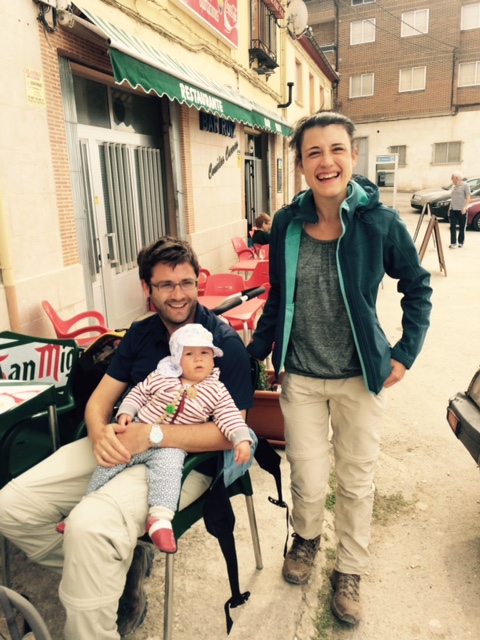
Fog City Boy #6

Fog City Boy on the Camino Portugués

Coimbra, Portugal – April 21, 2014


First a note to express my dismay that the images I had hoped you would be able to enjoy have not posted (consistently) with the rest of the blog. Son Noah has been instrumental in helping me improve my skills in utilizing the WordPress platform for the blog, and hopefully this post will show better results than earlier ones. If I am able to amend earlier posts to include the images consistently, I will post you to that effect.


Tomar proved to be a wonderful location for a recovery day. An ancient city and a home to the Knights Templar order in Portugal of the 12th and 13th century. That heritage is a matter of great local pride and the Templar cross is displayed ubiquitously in that town, including on the cobblestone sidewalks.


The Convent of Christ and the Templar castle overlook the city and dominate the horizon. I strolled up the mountain and enjoyed touring the historic site which is astonishingly well preserved. Here are several images from that visit.

photo 2
photo 2


As it happened, my visit coincided with the running of the annual Rali Tomar, and the castle was a waypoint on that rallye. All manner and vintage of vehicles had been tricked out for racing safety and operability and all mufflers had been removed. Among the 40 or so participating vehicles, I saw a VW bug, a Porche 912, and sundry others, but no Fords, Chevys, or Dodges. Sure are a lot of foreign cars in this country.


The Way from Tomar to Alvaiazere is just about 20 miles. It was a long day, to say the least. As I made my way out of Tomar, I came upon two other peregrinos – two Italian guys who looked to be in their 40s – who were studying the same guidebook I carry, albeit a later edition. They were cordial (haven’t met a pilgrim yet who hasn’t been) and we collectively figured out where we were supposed to go next. Sometimes neither the way marks nor the guidebook make clear the path. And there are places where the Way has been re-waymarked to accommodate changes to the landscape or for other reasons. Fortunately Gilberto was able to converse with a local denizen who pointed us in the right direction.


Gilberto and his buddy were intrepid and committed walkers. I kept up with them for a couple of hours, and then decided to chill for a while before pressing on. They had an agenda – to be to Santiago about three weeks before I intend to arrive. Given the choice between taking a break and keeping on walking, they kept on walking. As luck would have it, I caught up with them at the albuerque in Alvaiazere. That proved to be the first true albuerque I stayed at and it was a delightful experience. In addition to Gilberto and his friend, there was a couple from Dublin, Ireland. We had a nice dinner together and in time, Gilberto, his fellow pilgrim, and two other Italian perigrinos appeared at the neighborhood restaurant we had found, and we all had some laughs. Such is the society of peregrinos!


I allowed two days from Alvaiazere, through Ansaio and Rabacal, to Coimbra. There was some good country walking along this route. It was pleasant to be away from asphalt pavement for much of these two days.


Coimbra is an ancient university town and I have had the good fortune to be here for the Easter weekend. On the evening of Good Friday, I attended a mass at the old cathedral which featured classical vocal accompanyment to the intonations of the celebrants. It was lovely. The church was standing room only. On Saturday, I wandered up the hill to the university which occupies a number of blocks each of which houses a separate faculdade. By chance, I happened into one of the churches that are part of the university complex. The Archbishop of Coimbra was celebrating mass that morning.


The views from the university are remarkable, as is the statuary that adorns the campus. The statue is of D. Dinis (King Dennis) who was responsible for the university’s early development.


The seal of the university is recreated in stone cobbles within the main quadrangle.


I have had the opportunity to reflect on some of what I have seen in the three weeks I have been on the Way. Though the people seem to be pleased with life in general, the underlying economic problems are a stark reality. By this time I have seen literally hundreds of old and new houses for sale – the new ones the subject of foreclosures. RE/MAX and ERA signs abound, as do simple "VENDE-SE" pleas written in paint on the sides of buildings, with a phone number to call. Many small businesses are shuttered, likely for failure to pay the rent. Many old masonry buildings are in disrepair or collapse with the pensive "VENDE-SE" inscription affixed. The reality likely is that many of the older buildings have a negative present value. That is, their value is the cost of demolishing the structure and returning the underlying land to some productive use. A sad thing.


Yesterday, using Coimbra as my base of operations, I walked the 22 kilometers to Mealhada, returning to Coimbra in the late afternoon by rail. I’ll reverse that later today and continue north. The long treks are taxing, to be sure, but manageable. Break each piece into its smallest element and focus on each one, without concern for the last stroke or the next stroke. On the Camino, I think that means walk the Way today, one kilometer at a time.


With that, I’m off.


Knute Michael


Fog City Boy on the Camino del Norte